







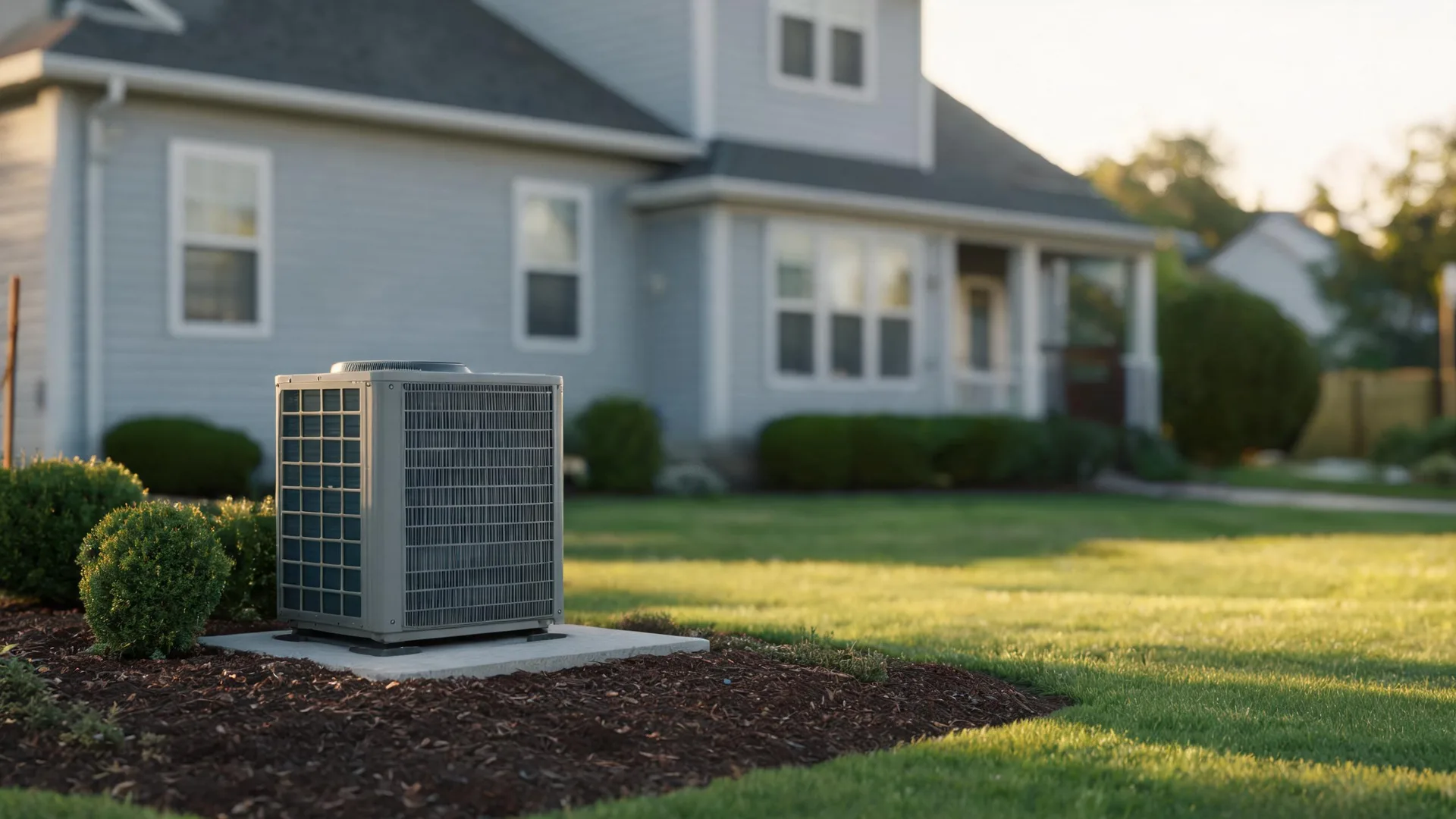
An outdoor HVAC condenser unit on a concrete pad in front of a two-story suburban house.

Heat Pump Installation in Milford, OH

Tell us about the job

Takes about a minute. No obligation.

New system or replacementHeat PumpClermont County, OH
Step 1 of 2

What ZIP code is the job in?

Electricity here ran 16.64 cents per kilowatt-hour in 2025, higher than most US counties pay. A heat pump run on electricity, so that rate applies to every hour it runs. Two systems can heat and cool the same house and land on very different bills, just because one holds its efficiency rating and the other doesn't. In a county where power already costs more, that gap matters more than it would somewhere cheaper. Sizing and installation decide which side of that gap you end up on.

7 months
October through April, your system heats
4 months
June through September, it cools
25°F
the average winter night it heats against
85°F
the average summer afternoon it cools against
Isometric line illustration of a cutaway single-story house showing interior rooms, ceiling ductwork and an indoor air handler, connected by a line to an outdoor condenser unit on a pad beside the building.
Your system heats October through April and cools June through September.

NOAA nClimDiv, 1991–2020 normals

Electricity heats close to half the homes in Clermont County.

A heat pump replacing an electric system fits what's already there.

Seven months of heat, four of cooling: this system barely gets a break here

Cooling runs June through September
Heat runs October through April
Climate zone 4A
Clermont County sees storms most places don't193 severe weather events hit the county between 2015 and 2024, and 18% of Ohio homes lost power for a day or more last year.

Clermont County falls under zone 4A in the 2021 energy code, a mixed climate that asks real work of both heating and cooling. Any split-system heat pump installed here has to meet the federal minimums for units built from 2023 on: at least 14.3 Btu of heat moved per watt-hour over the summer, and at least 7.5 Btu per watt-hour over the winter. That's the floor, not a target, so it narrows what a contractor can legally put in your home. A unit that only hits the minimum will cost more to run here than one built past it, since every watt-hour it uses gets billed at Clermont County rates.

Get the install right, and the rate you pay works for you

Sizing and installation decide whether a system holds its rating or falls short of it. That gets settled on install day, not after. Ask what efficiency the unit is rated for and what it takes to get it there in your house.

Find a contractor
A man in a cap, gray jacket and tan cargo pants, seen from behind, carries a worn canvas duffel bag up steps toward a dark navy front door, with a potted shrub beside the entry.
A gray heat pump outdoor unit mounted on a concrete pad next to the stone-accented exterior wall of a house.

What happens to the old unit on install day

The old system doesn't get hauled off the moment the new one shows up. A contractor disconnects the refrigerant lines first, and if the old unit still has a charge in it, that refrigerant gets recovered into a tank rather than vented, because venting it is illegal and has been for years. The electrical disconnect gets pulled, the line set gets cut loose, and the indoor coil comes out of the plenum. If the old system used a separate furnace or air handler alongside the outdoor unit, that comes out too, along with any electric strip heat kit that isn't being reused. What's left behind gets scrapped for the metal in it. None of this is the slow part of install day. The slow part is what replaces it: setting the new line set, checking the duct connections against what the new coil needs, and getting the charge right once everything's sealed. A system that gets rushed through that last step can run for years without ever hitting the efficiency it was built for.

Ask for the manual J, not a guess

A heat pump sized off square footage alone can end up wrong in both directions. Too big, and it short cycles, hitting the thermostat setting fast without running long enough to pull moisture out of the air, then shutting off and starting again. Too small, and it runs constantly through the hardest months and leans on backup heat more than it should. A manual J load calculation looks at the windows, insulation, and layout of the actual house to size the unit to the house, not the average.
Ask how they'll check the charge

A heat pump that's low on refrigerant or overcharged will still turn on and blow air, so the problem doesn't always show up right away. It shows up later, in a compressor working harder than it should and a unit that falls short of its rating. Getting the charge right means weighing in refrigerant or checking superheat and subcooling against the manufacturer's numbers, not just running the system until it feels cold. Ask which method the installer uses and whether they'll show you the readings.

That storm count matters most for where the outdoor unit ends up on install day. It sits outside, through wind and hail, so the pad location and clearance around it are worth asking about before it's set. A unit tucked near a fence or under a roof line without drainage takes more debris than one with open space around it. Ask the installer about surge protection on the disconnect too, since a power spike during a storm can take out the control board. And because outages happen here, ask what the heat pump needs to restart on its own once power comes back, and whether backup heat kicks in the same way. None of this changes what's in the unit. It changes whether the one you get keeps working when the county throws weather at it.

Installation day starts with a walkthrough, not a wrench. The installer checks where the line set will run, where the indoor coil ties into the plenum, and where the outdoor unit will sit before anything gets disconnected. Once the old system is out, the new line set gets brazed in and pressure tested, because a joint that leaks slowly can take months to show up as lost charge. The indoor coil goes into the plenum and gets sealed against the ductwork, since air pulled in around a loose seal never gets conditioned. The outdoor unit gets set, wired, and connected, then the whole system gets evacuated with a vacuum pump to pull out moisture and air before any refrigerant goes in. Only after all of that does the installer weigh in the charge and run the system to check it against the manufacturer's numbers. A job that looks finished once the unit is running isn't finished until those numbers check out.