Furnace tune-up before winter in Beavercreek, OH

Your furnace tune-up request goes to a pro who covers Greene County.

Get a local pro

A furnace tune-up before winter means a technician checks the burners, the igniter, the heat exchanger and the blower while the weather is still mild, so nothing fails once you need the heat every day. In Beavercreek, that means doing it before the cold settles in for good, not after the first hard freeze when a failed igniter leaves you without heat and without an easy appointment. Most homes here run on gas furnaces, and a tune-up includes testing the gas pressure and checking for a cracked heat exchanger, which is a safety issue as much as a comfort one. A furnace that starts the season clean and properly adjusted burns less gas to hold the same temperature, and it's far less likely to quit on the coldest night in January. The technician also replaces or checks the filter and confirms the thermostat is reading correctly, since a furnace working against a clogged filter or bad signal wears out faster than it should.

  1. Technician checks the thermostat calls for heat correctly

  2. Burners are inspected and cleaned of soot and rust

  3. Igniter is tested for a strong, steady glow

  4. Heat exchanger is checked for cracks or corrosion

Is your furnace ready for a Beavercreek winter

A furnace that skipped its tune-up usually tells you once it gets cold. It might take longer to kick on, blow air that smells faintly like dust burning off, or cycle on and off more than it used to. Some make a rattle or a click they didn't make last year. None of that means the furnace is done, but it does mean something inside is working harder than it should, and a furnace working harder is one more likely to quit on a night in January when you need it most. A cracked heat exchanger or a clogged burner left unchecked can also mean carbon monoxide isn't venting the way it should, which is a risk no homeowner wants to find out about the hard way.

A beige high-efficiency furnace stands on a concrete basement floor beside sheet-metal ductwork, with white PVC vent pipes and a gas line running along an insulated wood-framed wall.

After a tune-up

The burners burn clean and the igniter glows steady. The blower pushes air through the ducts at the rate it was built for. A technician has already caught the cracked heat exchanger or the failing capacitor before it left you without heat on a January morning.

An older metal furnace with a louvered front panel stands against a concrete basement wall, connected to sheet-metal ductwork and a flue pipe, with copper and steel pipes running alongside.

Skipped the tune-up

Dust has settled on the cabinet and the burners haven't been looked at in a while. The furnace still runs, but soot builds on the burners and the blower works harder than it should. Whatever is wearing out in there keeps wearing out until it quits.

A woman in a gray turtleneck sweater sits on a couch under a blanket indoors, looking out a window toward orange autumn foliage, with a bookshelf and plants behind her.
A woman with gray shoulder-length hair in a cream knit sweater sits in an armchair under a blanket, looking out a window at orange autumn foliage, with a living room, houseplant and wooden table behind her.
A woman with gray hair in a cream knit sweater sits on a light sofa by a large window, looking out at trees with autumn foliage, with a dark mug on a wooden side table nearby.
A gray-haired woman in a dark knit sweater sits on a couch with a cream blanket and patterned pillow, looking out a window toward yellow and orange autumn trees, with wooden shelves and plants in the room behind her.

A lot of what looks like a furnace problem is the furnace doing exactly what it's built to do. A dirty flame sensor will shut the burners down in seconds because it's reading a weak signal, not because anything is broken. Before the igniter ever fires, the inducer motor has to clear exhaust out of the heat exchanger first, so a furnace that won't start at all is often an inducer problem, not an igniter one. A technician checking airflow looks at static pressure in the ducts, since that tells you whether the blower is actually moving the air it should, not just whether it's turning. Short cycling usually traces back to a limit switch tripping from restricted airflow, which gets mistaken for a thermostat issue. Rollout switches cutting the gas valve are the furnace protecting itself the moment flame reaches outside the burner compartment, not a glitch to reset. And a blower motor pulling more amps than it used to is often the first sign of worn bearings, well before anything seizes.

What a technician actually checks

  • A dirty flame sensor reads a weak signal and shuts the burners down within seconds, even when the furnace is otherwise fine.
  • The inducer motor has to pull exhaust through the heat exchanger before the igniter is allowed to fire, so a failing inducer shows up as a furnace that won't start at all.
  • Static pressure in the ductwork tells a technician whether the blower is moving enough air, not just whether it's spinning.
  • A furnace that short cycles is often reading its own limit switch tripping from restricted airflow rather than a thermostat problem.
  • Rollout switches shut the gas valve the instant flame reaches outside the burner compartment, which is a safety response, not a malfunction to reset and ignore.
  • Amp draw on the blower motor climbs as the bearings wear, long before the motor seizes or trips its overload.
A gray high-efficiency furnace with white PVC vent pipes stands on a concrete pad in a basement, beside sheet-metal ductwork, copper piping and a poured concrete wall with wood framing at left.
The burners fire clean and the ductwork above stays tied into a furnace that's been checked before the first cold week hits.
A beige gas furnace in a basement with a metal flue pipe, galvanized sheet-metal ductwork to its left, and gas and water pipes along the concrete wall to its right.
An older furnace with no tune-up behind it has to prove itself the first hard freeze, with nobody having looked at the flue or the burners first.
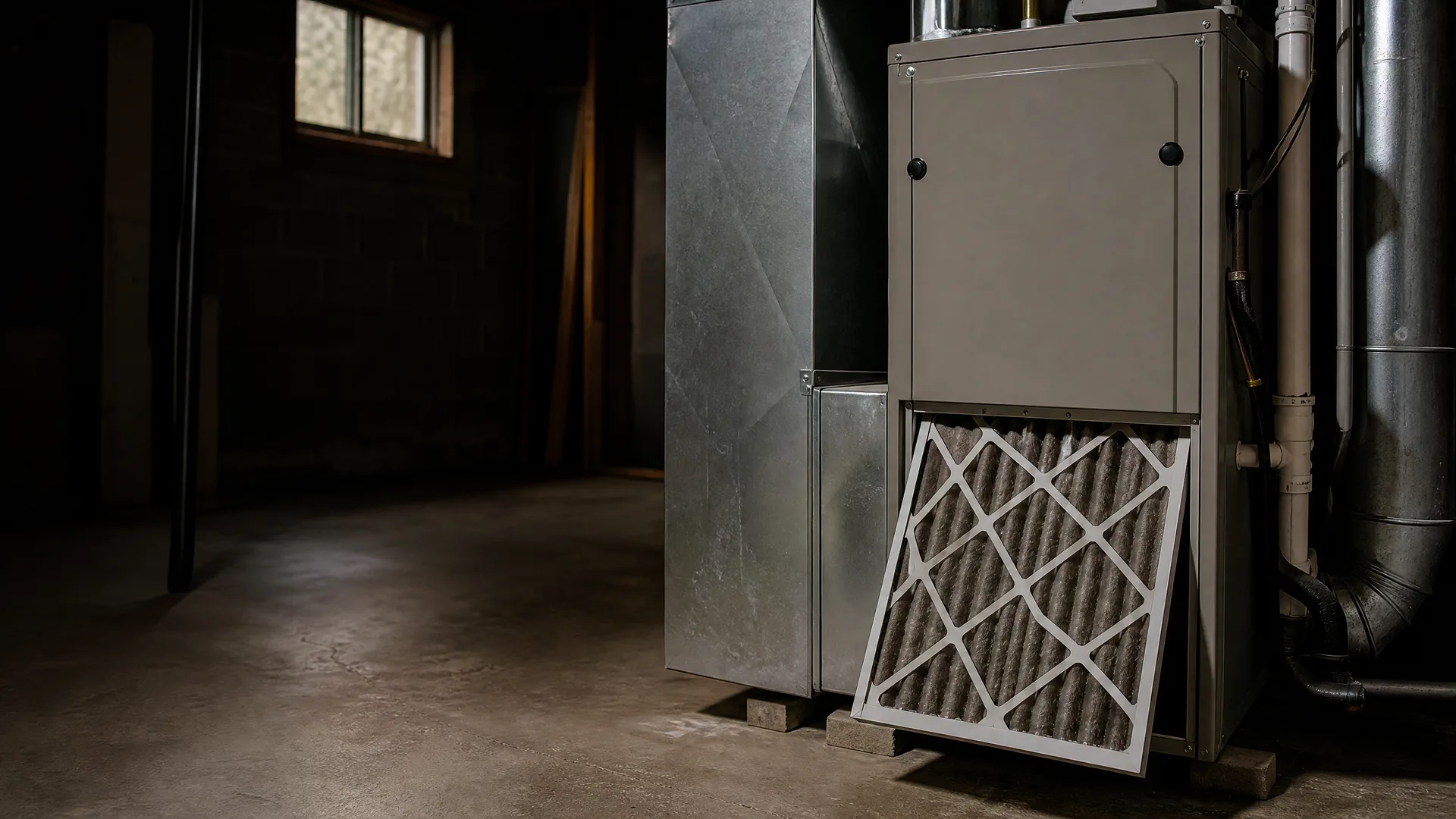
A gray furnace with sheet-metal ductwork in a dim basement, with a dirty pleated air filter leaning against its base on a concrete floor.

The filter is half out of its slot, and the dust on it is thick enough to see from across the basement. It is late October, still mild enough that the furnace hasn't had to run hard yet. You pulled it to look because the air coming up through the vent smelled off the last time it kicked on. Behind the filter, the burners are waiting, and so is everything else nobody's checked since last winter. A local technician who works on furnaces like this one all season would know in a few minutes whether the dust is the whole story or there's more waiting behind it.
Get matched with a furnace pro in Greene County

Greene County winters don't leave much room for a furnace to fail quietly. Once the cold settles in, you're running that furnace every day, and whatever was wearing out in October is what gives out in January. Getting it looked at now, while the weather's still mild, is the difference between catching a cracked heat exchanger on a technician's schedule or on the coldest night of the year, on yours. The contractor who gets your request works on furnaces around Beavercreek all season, knows what tends to fail on the units common here, and it's just the one contractor reaching out, not a handful competing for your call. That matters when what you want is someone who actually shows up and knows the furnace, not a bidding war. Your furnace has been sitting since spring. Before it has to carry you through another Ohio winter, it's worth knowing what shape it's in.

Why the heat exchanger matters most

Of everything a technician looks at during a tune-up, the heat exchanger is the one that can't wait for a symptom to show up. It's the metal chamber that separates the flame from the air blowing into your rooms, and once it cracks, exhaust can mix into that air instead of going up the flue. A furnace with a cracked heat exchanger can keep running and keep heating the house, which is exactly why it's dangerous. You won't smell gas or notice weak heat. A tune-up catches it before January, when that furnace is running most hours of the day instead of a few.

What a clean burner actually changes

Soot and rust on a burner change how the flame sits and how evenly it spreads along the burner tube. A furnace built to burn clean gas efficiently will run a weaker, uneven flame once that buildup sets in, and it has to work longer to put out the same heat. That shows up as higher gas use before it ever shows up as a problem you'd notice. Cleaning the burners in October costs the technician a few minutes. Waiting until the igniter won't catch a dirty flame in January costs you a no-heat call on a night you need the furnace most.

A beige metal furnace with a louvered front panel stands on a concrete floor against a concrete wall, connected to galvanized sheet-metal ductwork and a metal pipe.
Before you get your furnace maintenance
A gray high-efficiency furnace stands on a concrete basement floor beside sheet-metal ductwork, with white PVC vent pipes and a black flexible line running up to exposed wood floor joists, next to a wood-framed post against a concrete wall.
After you get your furnace maintenance

Scheduling it yourself

You can call around, compare a few companies, and book whoever answers first. That works fine if you already have someone you trust, or if you have time to ask each one what they actually check during a tune-up. Some outfits send whoever's free that day, not necessarily someone who knows your furnace or your area's winters. You're also the one juggling the calls back, the quotes, and figuring out which company to let in your house.

Getting matched with one contractor

You answer a few questions about your furnace and your house, and one licensed, local contractor reaches out to you, not five of them competing for your number. Someone who works on furnaces around Beavercreek every fall knows what tends to fail first in this area and what a Greene County winter asks of an older unit. You skip the part where you're vetting strangers and go straight to talking with someone who already does this work nearby.

Winter nights average 24°F

Once nighttime lows settle near 24°F here in December and January, your furnace is running most of the night just to hold the house steady. That's the stretch where a burner that was already struggling has to carry real weight. A tune-up done now catches that before the cold asks the furnace to prove it.

NOAA nClimDiv 1991-2020

A tune-up now costs you a visit while the furnace is already working fine, and the burners might turn out clean, the heat exchanger sound, nothing to fix.

Skip it, and you find out what shape the furnace is in on the first night it has to run for twelve hours straight, with Beavercreek already below freezing outside.

How long does your furnace need to hold up this winter?

  • Winter nights average 24°F

    Overnight lows average 24°F here in December and January, so the furnace runs for hours at a stretch, not in short bursts.

  • Heat runs October through May

    Heat stays on here from October through May. That's eight months for a weak part to wear down further and finally quit.

  • 60.2% of homes heat with gas

    60.2% of homes in the county heat with gas, same as yours likely does, which is why the burners and heat exchanger matter most at tune-up time.

NOAA nClimDiv 1991-2020 · ACS 2020-2024

A woman in a cream cardigan and jeans stands with one hand raised facing an open front door of a gray horizontal-siding house, with a black lantern wall light, a potted shrub with yellow flowers, and a stone-faced porch column.

A furnace that's been checked is one less thing to worry about this winter

A tune-up before the cold sets in means someone has already looked at the burners, the igniter, the heat exchanger and the blower while there was still time to fix what needed fixing. That's the whole answer. The furnace that gets checked in October isn't the one that leaves you without heat in January.

Finding a contractor to do that work doesn't have to mean calling around Beavercreek and comparing quotes. Submit your information once and you get matched with one licensed local contractor, someone who works on furnaces like yours all season and knows what tends to fail first in a house around here. They'll reach out to you directly. No list of companies competing for your callback, just the one who's actually suited to the job in front of them.

Interior corner with sheer white curtains at a window, a brown upholstered sofa in the foreground, and a wooden multi-drawer cabinet holding a round ceramic vase with leafy branches.
A woman in a cream knit sweater sits in an armchair with her eyes closed and head tilted back, beside an open window showing orange and yellow foliage, with a mug on a small round table and a bookshelf behind her.
An older man with gray hair and a beard, wearing a dark blue fleece zip jacket, leans back in an upholstered chair with his eyes closed in sunlight near large windows, with a potted green plant and bare trees behind him.

Furnace Maintenance

A local pro for your furnace maintenance

Your request stays with one local pro.

A black smartphone standing upright on a plain white background, its screen filled with solid green.
Tune-up, service, or cleaningFurnace or heatingGreene County, OH
Step 1 of 2

What ZIP code is the job in?