How long a furnace lasts in Beavercreek, OH

Your new furnace project goes to an installer who works in Greene County.

Get my match

How long does a furnace last in Beavercreek, OH?

You're wondering if your furnace is on borrowed time or still good for a few more winters. Furnaces don't fail on a schedule, but there's a general range most of them fall into, and knowing it helps you figure out whether to plan for a repair or start thinking about replacement before the next cold stretch hits.

A furnace lasts 15 to 20 years

Most furnaces run 15 to 20 years before they need to be replaced, and gas furnaces, which is what most homes around Beavercreek use, tend to land in that same range. The burners, the heat exchanger and the blower motor all wear down with use, and a furnace that's run every winter for two decades has put in a lot of hours. Greene County winters are cold enough that a furnace works hard for several months straight each year, which adds up over time. If your furnace is past 15 years, it's worth paying attention to how it's running, since problems tend to show up more often as a system nears the end of that range.

A beige high-efficiency furnace with white PVC vent pipes stands beside galvanized sheet-metal ductwork in a basement with a concrete floor, exposed wood studs, and metal piping along the wall.

Running the way it should

A furnace like this vents through PVC pipe and sits quiet most of the time it's on. It starts when the thermostat calls, heats evenly, and shuts off without drama. No burning smell, no short cycling, no rooms that lag behind the rest of the house.

An older beige furnace with a louvered vent panel stands on a concrete basement floor beside galvanized sheet-metal ductwork, a metal flue pipe and vertical pipes along a concrete wall.

Showing its age

A cabinet like this cream-colored one, with a flue pipe running up into the block wall instead of PVC out the side, is an older design. If yours runs longer to reach the same temperature, clicks before it lights, or needs a repair more winters than not, it's telling you something.

Why is your furnace acting like this lately

Maybe it's taking two or three tries to light some mornings, or you're hearing a bang when it kicks on. Maybe one room upstairs never quite gets warm no matter where you set the thermostat, or you've noticed a burning dust smell that doesn't go away after the first few minutes. The gas bill might be higher than last winter even though you haven't changed the thermostat setting. On its own, any one of these could be minor. Together, or if they're getting worse, they usually mean something inside is wearing out. Left alone through a Beavercreek winter, a furnace in this shape can fail on the coldest night of the year, not a mild one.

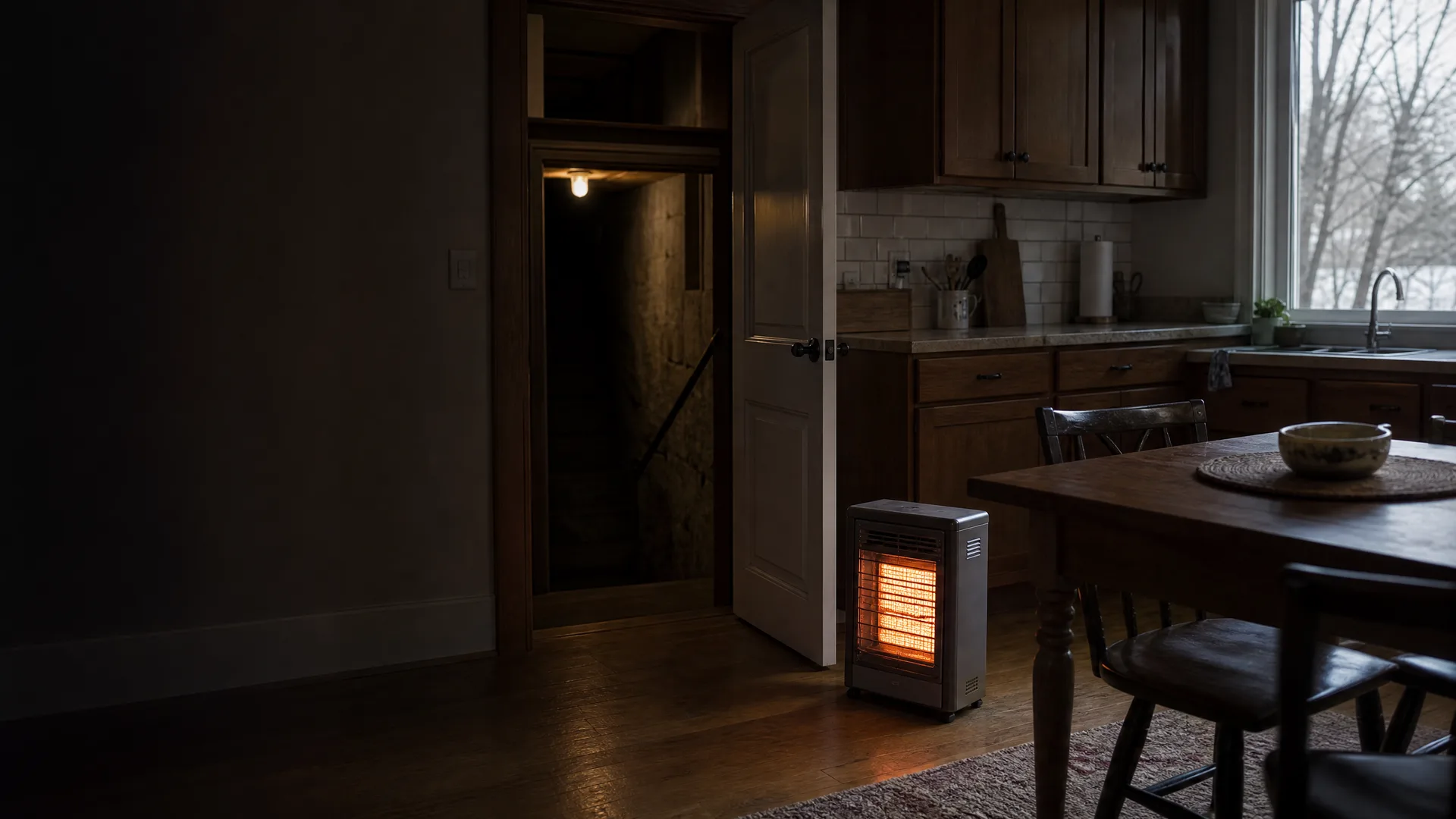
A dim kitchen and dining area with wood cabinets and table, an open door to a lit basement stairwell, and a portable space heater with glowing elements on the floor.

You're up before the rest of the house, and the kitchen is cold enough that you can see your breath near the window. The space heater's been running since 5 a.m., its coil throwing a small orange circle of light across the floor tiles. The basement door is open behind it, you left it that way last night when the furnace made that banging noise again and you went down to look. Greene County mornings in February don't forgive a furnace that's quit trying. You still have to get the kids up and fed, and the thermostat reads sixty-one. You stand there a minute with your coffee, listening for the burner to catch.

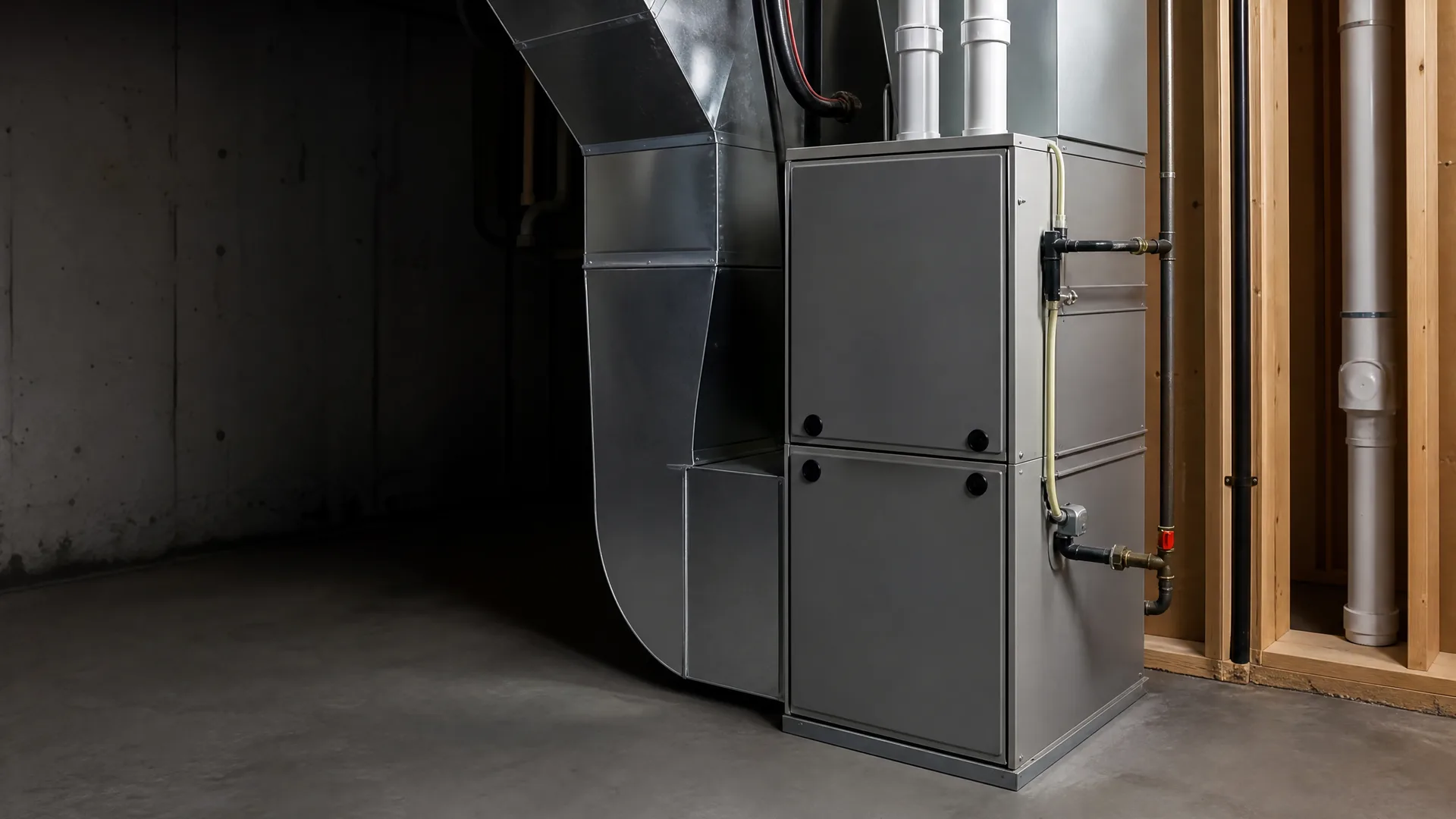
A gray high-efficiency furnace with two PVC vent pipes stands in an unfinished basement beside sheet-metal ductwork, a framed and plastic-covered wall, and a bare concrete wall with vertical pipes.
Set on a solid pad with the ductwork and flue secured, this is a furnace installed to last out its years.
A gray furnace cabinet in a basement, connected to galvanized sheet-metal ductwork and white PVC pipes, against a concrete wall with exposed metal piping and insulation overhead.
Propped on a wooden pallet with no permanent base, this furnace was set up to fail early no matter its age.

A gas furnace heats by pulling air across a heat exchanger, a metal chamber where burners fire and combustion gas passes through without mixing into the air that reaches your rooms. That exchanger is the part that decides the furnace's age more than anything else. Heat it and cool it every cycle for enough winters and the metal fatigues, and small cracks start to form. A cracked exchanger is why a furnace gets condemned rather than repaired, since a crack there can let combustion gas mix into the air moving through your ducts. Technicians check it during every tune-up for exactly this reason, looking for hairline separations or discoloration that signals metal under strain. The blower motor, igniter, and gas valve all get replaced over a furnace's life without much argument. The heat exchanger doesn't get replaced. When it goes, the furnace goes with it, which is why its condition matters more than the number on the install sticker.

An older man with gray hair and a beard, wearing a dark coat flecked with snow, stands smiling in a dimly lit home hallway with lamps, a framed picture, and a wooden door.
A gray-haired, bearded man in a dark coat dusted with snow stands just inside an open door of a warmly lit home, looking off to the side.
An older bearded man in a dark snow-dusted coat and gray scarf stands just inside a dimly lit home entry, with a framed picture, lit table lamp, and an adjoining room with a fireplace behind him, and snow visible through the open door.
A gray-haired bearded man in a dark coat and scarf dusted with snow stands smiling in a dimly lit entryway with a white front door, a side table with a lit lamp, an oval mirror, and a patterned rug.

15 to 20 years

That's the typical working life for a gas furnace with regular upkeep. Past that range, parts wear faster and a breakdown in the middle of a Greene County winter gets more likely.

Answer a few questions

One cracked heat exchanger

That alone ends a furnace's life, no matter its age. Once it's cracked, replacement is the only safe option, not repair.

Answer a few questions

Repair the Furnace or Replace It

Repair it

  • The heat exchanger is still sound, so the furnace can keep burning gas safely for more winters.
  • A single part failure, like an igniter or a draft inducer motor, is a contained fix rather than a sign of broader failure.
  • The furnace is under 15 years old, which is within the range where parts and labor still make sense against buying new.
  • You've had no more than one or two repairs in the past couple winters, not a pattern of recurring calls.
  • The cabinet, blower and ductwork show no rust or damage beyond the one part that failed.

Replace it

  • The heat exchanger is cracked, which means no repair can make the furnace safe to run again.
  • The furnace has passed 15 to 20 years of service, putting it past the range where parts hold up reliably.
  • Repairs are stacking up within the same year or two, each one a sign the furnace is wearing out broadly, not narrowly.
  • Efficiency has dropped enough that the gas bill runs noticeably higher for the same heat output.
  • The furnace was installed on a pallet or without a secured flue, meaning it was never set up to reach its full years in the first place.
A gray metal furnace with two white PVC vent pipes stands on a concrete floor beside galvanized sheet-metal ductwork in a basement or utility space with wood framing.
Before you get your furnace installation
A gray furnace cabinet in a basement with sheet-metal ductwork, white PVC vent pipes, and black gas piping against a concrete wall and wood-framed partition on a bare concrete floor.
After you get your furnace installation

Get the right pro for your furnace

By now you have a sense of where your furnace stands, whether it's deep into that 15 to 20 year range or showing one of the signs that point to the heat exchanger rather than a part you can swap out. If a new furnace is what you're looking at, the next part is the slow part: finding a contractor who answers the phone, comes out to actually look at your ductwork and your house, and gives you a straight number instead of a guess. That usually means calling around, explaining the same thing three or four times, and waiting on quotes that show up days apart and aren't easy to compare. Winter in Beavercreek doesn't wait on that process, and a furnace that's already struggling in December won't get more patient while you sort through estimates. Handing that search off now means one contractor who knows the job reaches out to you directly, instead of you chasing several.

The order your furnace fires

  • Ignition starts the sequence: an igniter or pilot lights the burners inside the firebox before anything else moves.
  • A draft inducer motor pulls combustion gas through the heat exchanger and out the flue before the burners are allowed to fire.
  • The blower doesn't start until a sensor confirms the heat exchanger is actually warm, usually a 30 to 45 second delay.
  • Air from your rooms never touches the flame directly, it only passes over the outside of the heat exchanger and picks up heat that way.
  • A flame sensor watches the burners the whole time they're lit and cuts gas flow if it stops detecting a flame.
  • Once the thermostat is satisfied, the burners shut off first and the blower keeps running for a short while to pull remaining heat out of the exchanger.

Turn the thermostat up and a sequence starts, in order, every time. The igniter or pilot lights first, inside the firebox, before anything else is allowed to happen. Then a draft inducer motor spins up and clears the heat exchanger and flue of combustion gas so nothing backs up into the house once the burners fire. Only after that does the blower turn on, and it waits because a sensor has to confirm the exchanger is actually warm first, usually half a minute or so. That delay is why you feel a puff of cool air for a moment before the warm air starts.

The air moving through your ducts never touches the flame. It passes along the outside of the heat exchanger and picks up heat through the metal, which is the whole reason that part matters more than any other in the furnace. While the burners are lit, a flame sensor watches them the entire time. If it stops reading a flame, even for a moment, it cuts the gas rather than let it keep flowing unburned.

When the thermostat is satisfied, the burners shut off first, but the blower doesn't stop right away. It keeps running a short while longer, pulling the last of the heat out of the exchanger instead of letting it go to waste. That tail end of blower noise after the burners cut out is normal and by design, not a sign anything is wrong.

Why does a furnace work this hard in Beavercreek

  • Winter nights average 24°F

    Winter nights average 24°F here, per NOAA climate data for Greene County. That kind of cold keeps a furnace firing long and often, which wears parts down faster.

  • Heat runs October through May

    Heat runs October through May in Greene County, close to eight months of the year. That's eight months of cycles on the igniter, the inducer motor, and the heat exchanger.

  • 60.2% of homes heat with gas

    Census data puts gas heat in 60.2% of Greene County homes. Gas furnaces carry that heat exchanger, the part whose condition decides whether yours is near the end or not.

NOAA nClimDiv 1991-2020 · ACS 2020-2024

  1. Thermostat calls for heat and signals the control board to start.

  2. Draft inducer motor spins up and clears the heat exchanger first.

  3. Igniter glows hot enough to light the gas at the burners.

  4. Burners fire inside the firebox and heat the exchanger walls.

Winter nights average 24°F

At 24°F overnight, your furnace can't just take the edge off and shut down. It has to hold that heat for hours on end, night after night, all winter. That kind of steady run time wears burners and blower parts faster than a mild climate would.

NOAA nClimDiv 1991-2020

A woman wrapped in a chunky knit blanket sits in an armchair with an open book on her lap, beside a lit table lamp and a window with frost and snow outside.
A smiling older woman with short light hair in a beige knit sweater sits in a dimly lit kitchen beside a window at night, with a round loaf of bread on a wooden board in the foreground.
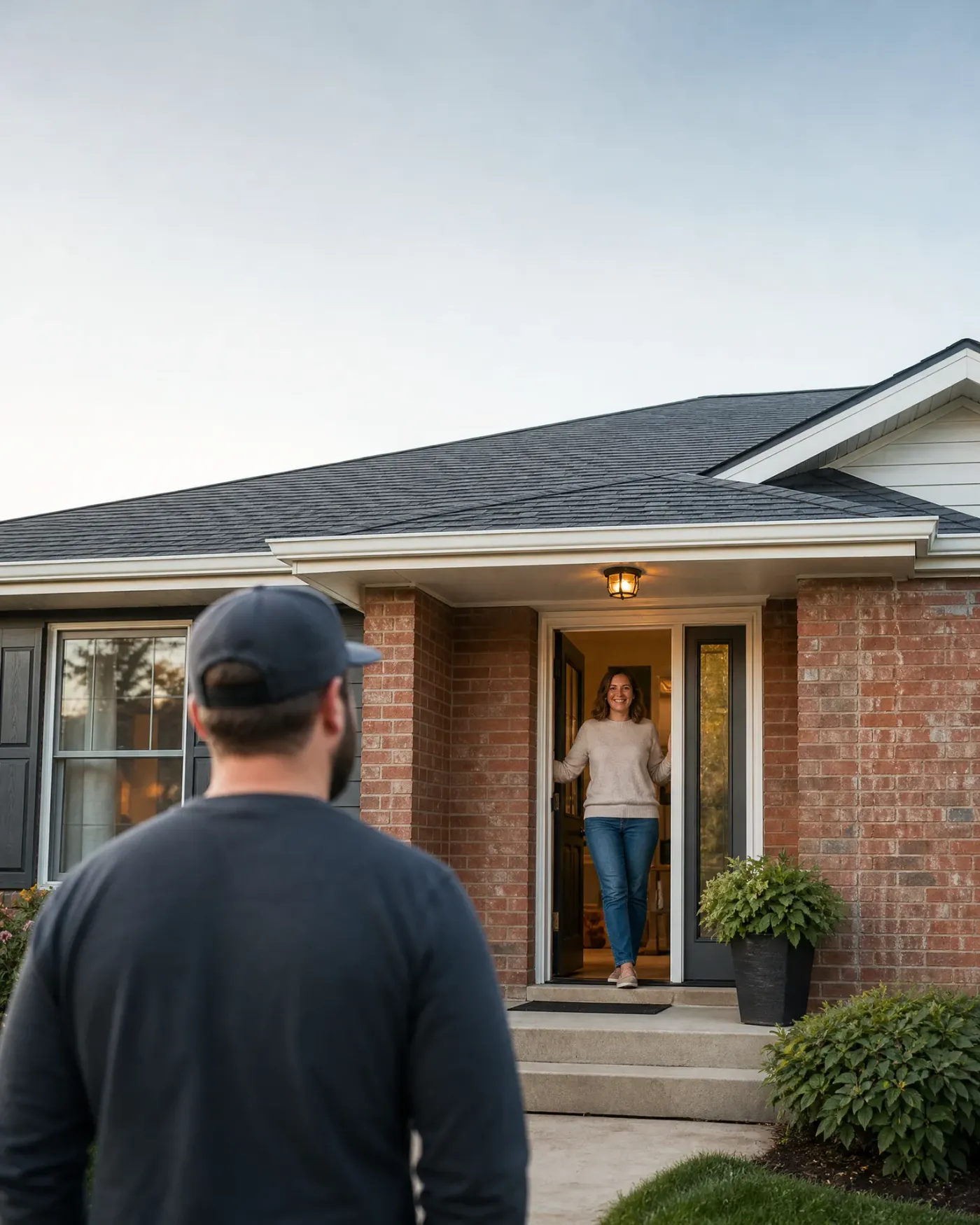
A woman stands smiling in the open front doorway of a single-story brick house while a man in a dark cap and long-sleeved shirt, seen from behind out of focus, faces her from the walkway.

Where that leaves your furnace

Most gas furnaces run 15 to 20 years with regular upkeep. A cracked heat exchanger ends that life early no matter the age on the furnace, while a failed igniter or draft inducer motor is just a part to replace. Somewhere between those two facts is where your furnace stands right now, and by this point you likely have a sense of which side it's on.

If it's time to replace rather than repair, the work ahead is finding someone who can look at your specific setup, ductwork, venting, the space it sits in, and give you a straight answer. That usually means calling around, explaining the same problem more than once, and sorting through quotes that don't quite match up. Getting matched with a contractor who serves Beavercreek skips that part. They'll reach out to you directly, already knowing what you're dealing with.

A gray upholstered sofa with a beige cushion and knit blanket beside a curtained window, with a white mug and a book on a dark wooden table in the foreground and a lit lamp in the background.
A gray furnace with attached sheet-metal ductwork and PVC vent pipes stands in a basement with concrete walls and floor beside exposed wood framing and vertical pipes.

A pro who works on furnaces

New system or replacementFurnace or heatingGreene County, OH
Step 1 of 2

What ZIP code is the job in?