Why heat pumps struggle in sticky Montgomery County summers

Explain the job once and skip repeating it on every call.

RepairHeat PumpMontgomery County, OH
Step 1 of 2

What ZIP code is the job in?

Why does my heat pump struggle to cool my house in summer?

Montgomery County summers run humid, and a homeowner whose heat pump is running constantly but not keeping the house comfortable wants to know whether that is normal or a sign something is wrong with the unit.

It's working harder than it should because of the humidity, and that strain is often what pushes a weak unit into a real breakdown.

A heat pump cools by moving heat out of your house, and it pulls moisture out of the air at the same time. In a sticky Dayton-area summer, there's a lot more moisture to pull, so the system runs longer to reach the same temperature on the thermostat. A heat pump that's low on refrigerant or has a dirty coil can usually still cool a house on a mild, dry day. Once the humidity climbs, that same unit falls behind, runs constantly, and still leaves the house feeling damp. That's usually the point a homeowner notices something is wrong, even though the underlying problem was there all along.

A dark bedroom at night with an unmade bed and a pillow beside a rain-streaked window showing distant lights and trees outside.

It's past eleven and the bedroom is still thick. You kicked the top sheet off an hour ago and it's still damp where your legs were. The window is fogged along the bottom edge, that film that shows up when the air outside has nowhere to go. You can hear the heat pump running outside, steady, not cycling off the way it used to. The thermostat says 74 but the room doesn't feel like 74. It feels like the air is just sitting on you. You get up once to check the vent, hold your hand near it, and the air coming out is cool enough. It just isn't doing anything about the wet, heavy feel of the room. You lie back down on the dry side of the pillow and wait for it to catch up.


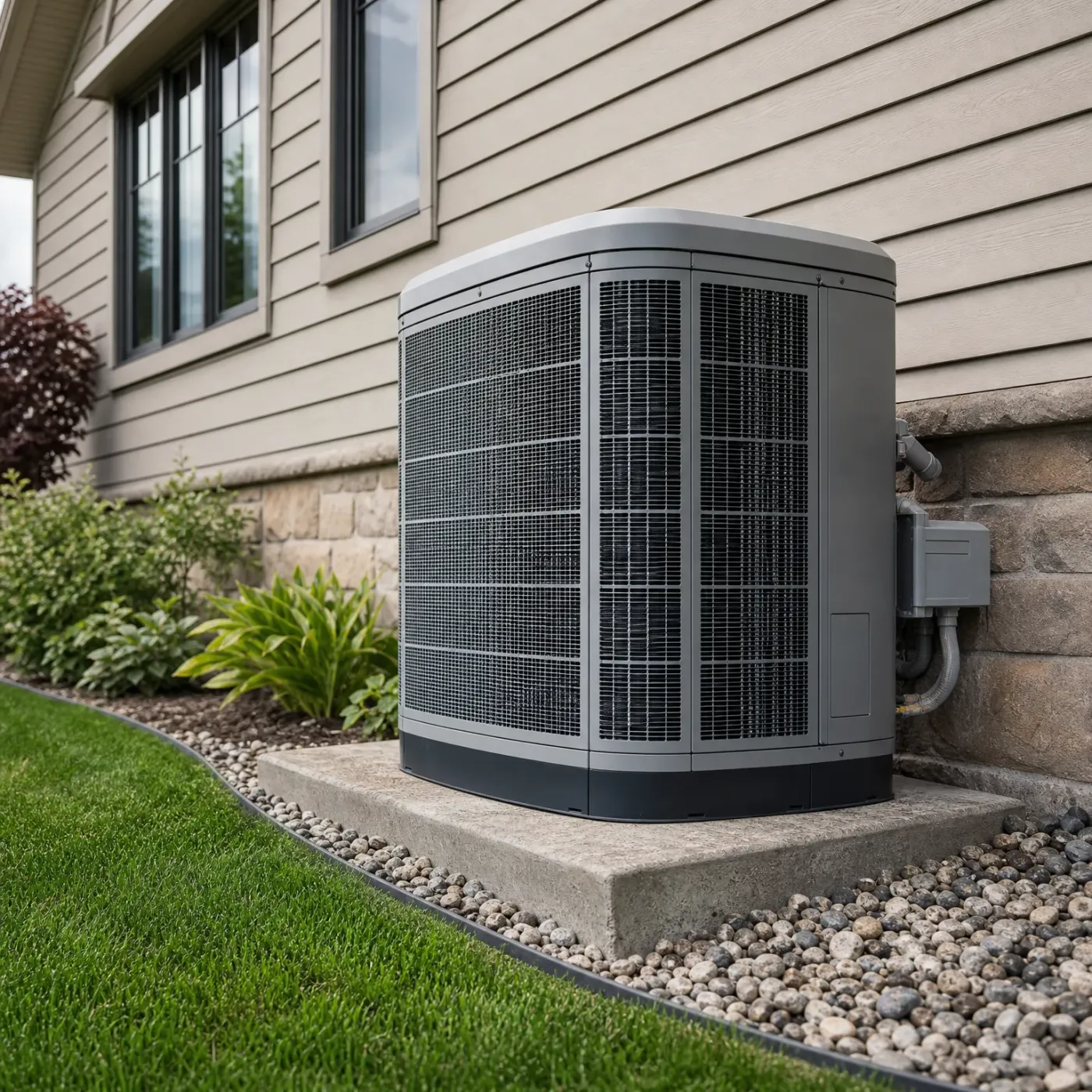
A gray outdoor condenser unit on a concrete pad beside a house with gray lap siding, connected by conduit and refrigerant lines to a wall-mounted disconnect box, with a green shrub and mulch bed at left.
A clean coil and a clear space around the unit let it shed heat the way it's supposed to, even on a heavy, wet afternoon.
An outdoor air conditioning or heat pump condenser unit on a concrete pad beside a house with horizontal vinyl siding, a gray electrical disconnect box and conduit on the wall, and a concrete walkway in the foreground.
Dirt on the coil and a cabinet full of grime make the unit work harder to dump heat, and that's often where the breakdown starts.
  1. Warm humid air crosses the indoor coil and gives up heat.

  2. The coil chills below the dew point and pulls moisture from the air.

  3. Water collects on the coil and drips into the condensate pan.

  4. The condensate line carries that water out to a drain.

Power here costs 15.91 cents per kilowatt-hour

At 15.91 cents per kilowatt-hour, every extra hour your heat pump runs fighting humidity shows up on the bill. A unit that's low on charge or icing over has to run longer to pull the same moisture out of the air, so the cost of ignoring it climbs with the humidity, not just the heat.

EIA-861 2025

Running right versus running weak

A heat pump that's cooling properly in Montgomery County holds close to your thermostat setting and the air coming out of the vents feels cold and dry against your hand. The house loses that sticky feel within an hour or two of the unit kicking on, and it cycles off sometimes instead of running nonstop. A heat pump that's struggling keeps running long after the thermostat should be satisfied, and the air at the vents feels cool but not cold. You notice the humidity more than the temperature. Rooms farther from the unit stay warmer, and the system seems to be working just as hard whether it's a mild afternoon or the worst of a humid stretch.

What it takes to find out

Telling the two apart from inside the house is hard, since a low charge, a dirty coil, and a thermostat set wrong can all feel the same at eleven at night. Sorting that out usually means someone looking at the refrigerant pressures, the coil, and the condensate line directly. That's a different search than most people want to run on a hot night: finding a contractor who works on heat pumps specifically, calling until someone picks up, explaining the symptoms again to each one, then comparing quotes that may not even be for the same fix. A request through this page goes to one licensed contractor local to Montgomery County, so you're not fielding calls from five companies to get an answer, and asking costs nothing.

A gray-haired man in a dark long-sleeve shirt sits on a gray sofa in a living room, looking toward a sunlit window with sheer curtains.
A gray-haired man in a dark green sweatshirt sits on a sofa in a living room, looking toward a bright window, with a houseplant, lamp, fireplace and framed art behind him.
A gray-haired bearded man in a dark green collared sweater sits on a sofa in a living room with a window, houseplant, floor lamp and bookshelves, looking off to the side.
A gray-haired man in a dark green sweater sits on a sofa in a sunlit living room, looking off to the side, with a framed landscape painting, dining table and shelving behind him.
A gray outdoor condenser unit on a concrete pad beside a house with horizontal lap siding and a stone foundation, with a lawn, shrubs and decorative gravel nearby.

Skip the calls to every shop

The pro who reaches out is licensed in Ohio.

Skip searching for a heat pump pro and answer a few questions instead.

Get one local pro

It costs nothing to send, and you don't have to hire anyone.

Call a repair line or search on your own

On your own

  • You call around to a handful of Montgomery County contractors and describe the same sticky-house, long-runtime problem to each one.
  • You compare quotes without knowing if each contractor priced the same fix, since one might quote a recharge and another a coil cleaning.
  • Multiple companies call back at different times, and you field each one while still dealing with a warm, damp house.
  • You're left guessing which contractor is actually licensed to work on a heat pump versus one that mostly installs furnaces.

Submit a request

  • One request goes to a single licensed, local contractor who works on heat pumps in Montgomery County, not a list of them.
  • You explain the problem once, including what you've noticed about runtime and humidity, instead of repeating it on multiple calls.
  • The request is free with no obligation, so you can hear what's going on with the unit before deciding anything.
  • You're not fielding calls from several companies at once while you're trying to get the house cool again.
A gray outdoor condenser unit on a concrete pad beside a house with stacked stone and horizontal siding, surrounded by gray gravel and a plain light wall.

A heat pump sized right

A heat pump matched to your house pulls enough moisture out of the air to keep the coil from icing over even when the outdoor air is thick. It cycles on long enough to dry the air, then shuts off, and the house holds that feeling through the afternoon. The outdoor unit has room to exhaust heat and the indoor coil stays clean enough to do its job without extra strain.

A dark gray outdoor heat pump unit sits on a concrete pad beside a white stucco wall and lap-sided house corner, with mulch and a small shrub in the foreground.

A heat pump sized wrong

A heat pump that is too small for the house never catches up once a Montgomery County afternoon turns humid. It runs long hours without pulling the house down to temperature, and the coil can ice over trying. One that is too large shuts off before it has pulled enough moisture out, so the house reads cool on the thermostat but still feels damp. Either way the fix is a contractor checking the sizing against the house, not just the refrigerant charge.

How long does your heat pump have to work each year?

  • Winter nights average 24°F

    Winter nights here average 24°F, cold enough that your heat pump leans hard on backup heat to keep up.

  • Heat runs October through May

    Heat runs October through May here, eight months of the system cycling on to keep the house warm.

  • Cooling runs June through September

    Cooling runs June through September, four months when the same unit has to pull both heat and humidity out of the air.

NOAA nClimDiv 1991-2020

A woman with shoulder-length brown hair wearing a beige knit cardigan sits in a gray upholstered armchair near a window, looking off to the side with a slight smile, with bookshelves blurred in the background.
A woman with her hair in a bun holds a sleeping young child against her chest, both wrapped in a textured beige knit blanket on a sofa in a dimly lit room with a lamp, framed picture, and bookshelf behind them.
A closed silver laptop and a glazed ceramic mug on a wooden table, with a blurred kitchen counter, potted plant, cutting board and window in the background.

You feel it before you see a number on the thermostat

A heat pump that's losing the fight with humidity shows up in small ways first. Wood floors feel tacky. A closet that backs up against an outside wall starts to smell faintly musty. Bathroom mirrors take longer to clear after a shower because the air in the house already holds more moisture than it should. None of that trips an alarm. It just sits there, and most people blame the weather instead of the unit.

Left alone, it costs you twice. The system runs longer to chase a setpoint it can't hold, so your bill climbs through the muggiest stretch of summer. And a coil that keeps icing over or a condensate line that keeps backing up puts strain on parts that aren't cheap to replace. Finding someone to look at it shouldn't be its own project on top of that. Instead of calling several Montgomery County companies, describing the same sticky-house problem each time, and weighing quotes you can't fully compare, you submit the details once. A licensed local contractor gets matched to the job, and only that one contractor calls you back.

Interior corner of a living room with a beige upholstered sofa and dark cushion in the foreground, a ceramic vase of leafy branches on a dark side table by a curtained window, a framed picture on the wall, and a wood-surround fireplace at right.
A gray outdoor air conditioner or heat pump unit on a concrete pad beside a house with horizontal lap siding, with conduit and refrigerant lines running up the wall and green shrubs and mulch at left.

Running the way it should

The coil and grille stay clean enough for the unit to dump heat straight into the air around it. Refrigerant lines run tight into the house, shrubs are kept clear of the cabinet, and the unit cycles on, does its job, and shuts off.

An outdoor air conditioning condenser unit on a concrete pad beside a house with horizontal siding and a concrete foundation, with refrigerant lines running to a wall-mounted disconnect box and shrubs at left.

Falling behind on a sticky afternoon

Dust has built up across the grille until it darkens the metal, and that buildup blocks the airflow the unit needs to shed heat. On a muggy Montgomery County day, a cabinet this dirty forces the unit to run longer and still lose ground.

A heat pump that keeps losing ground to Montgomery County humidity has something specific wrong with it, whether that's a low charge, a dirty coil, or a unit that was never sized right for your house, and a qualified contractor can tell you which. You don't have to be the one who figures that out. A local contractor who works on heat pumps all summer has seen this exact complaint, sticky house, long runtime, water where it shouldn't be, enough times to know what to check first. You get matched with one contractor, not a handful, so you're not fielding calls from three different companies and trying to decide whose quote actually fixes the problem. You explain it once, to someone licensed to work on your system who shows up knowing the humidity here doesn't let a weak unit coast. From there, it's a diagnosis, a repair, and a house that finally dries out the way it's supposed to.

Close view of a dark standing-seam metal roof with a stone chimney and metal flue cap, overlooking a wide river, trees, and flat farmland under a partly cloudy sky.

Skip calling around

Describe it once

No charge to send it. You decide if you hire them.

One call covers it. You describe the sticky rooms and the long runtimes once, to a contractor who works on heat pumps around Montgomery County all summer and knows what a struggling unit usually needs.