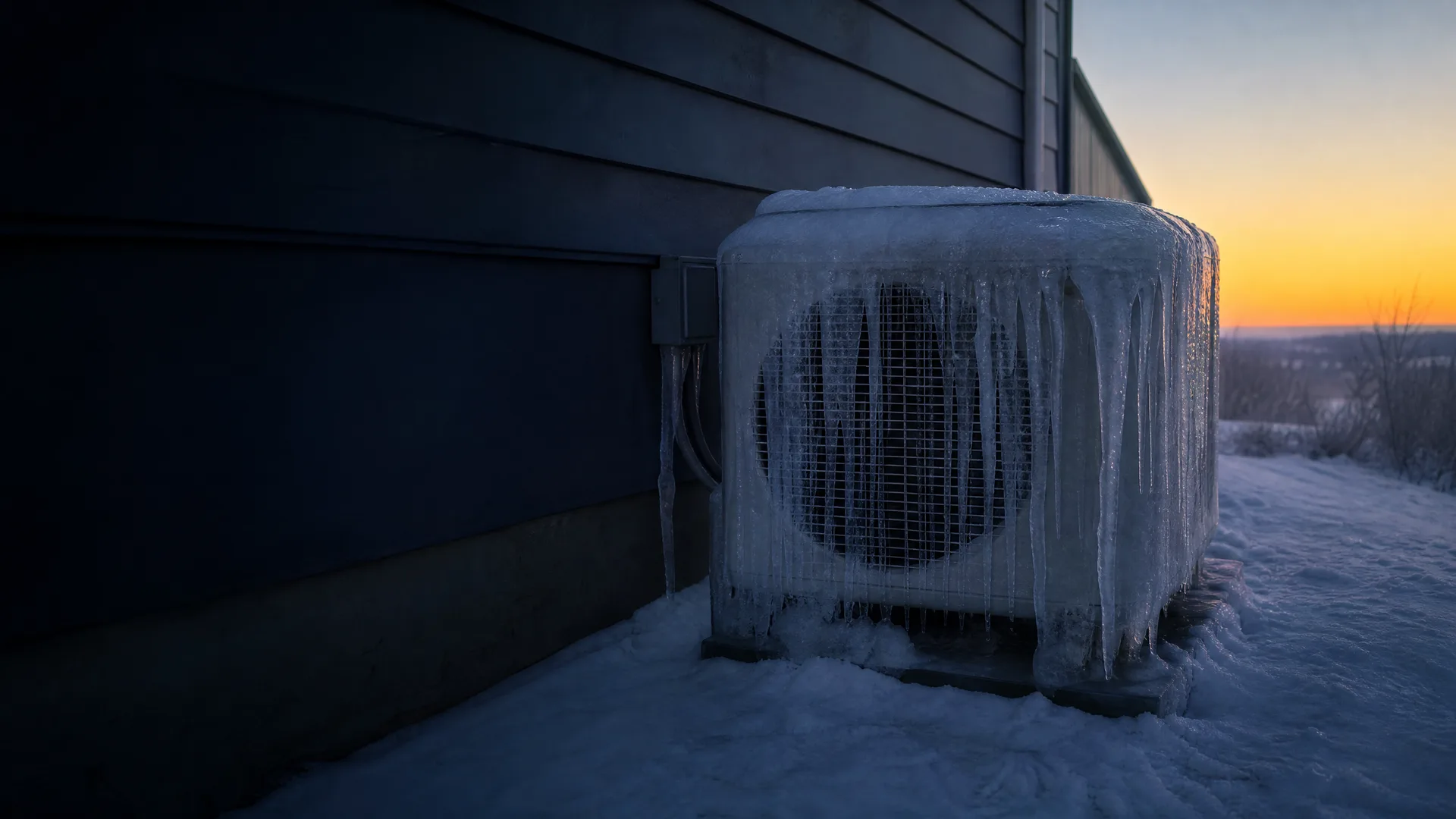
Why heat pumps freeze up in cold Stark County winters
Get matched with a pro who works on heat pumps in Stark County.
A little frost on the outdoor unit during a cold snap is normal. Your heat pump should run a defrost cycle, melt it off, and go back to work. What's not normal is a unit that stays coated in ice, or one that's sheathed in a solid block after a Stark County cold stretch. That points to something that needs a technician's eye, not a few hours of sun.
Cold air holds less moisture, but your outdoor coil is still colder than the air around it, and that's enough to pull frost onto the metal every time temperatures drop into the 30s and below. The defrost cycle is supposed to handle that automatically. When it doesn't, something in the system isn't doing its job: a sensor, a reversing valve, a fan motor, low refrigerant. Figuring out which one takes someone who can test the unit, not guess from what it looks like outside.
If this is happening at your house, you're probably not looking forward to the part where you find someone to look at it. Calling around for quotes, explaining the same freeze-up to three different companies, trying to tell which one actually works on heat pumps instead of furnaces alone. That's the part that gets handled here. You answer a few questions about what your unit is doing, and a contractor who works on heat pumps in Stark County gets in touch with you directly.
Ohio winters push heat pumps harder than homes in milder climates, and a unit that ices over repeatedly is losing efficiency every time it does, on top of whatever is already wrong with it. Getting someone out to look at it sooner rather than later is worth doing. The search for who to call is the part you can skip.
Why does my heat pump keep freezing up in winter?
You've already noticed the frost isn't melting off the way it's supposed to. The outdoor unit is iced over, maybe even solid, and it's staying that way through a stretch of cold Stark County weather instead of clearing itself the way it did before. You want to know if this is just how heat pumps act in a hard freeze, or if something's actually gone wrong with yours.
A heat pump that won't clear its own ice has a part failing, not a weather problem
A heat pump melts frost off itself by reversing briefly, sending warm refrigerant through the outdoor coil. That cycle depends on a sensor to tell it ice has built up and a reversing valve to actually switch directions. When either one fails, the unit keeps running in heating mode straight through the ice instead of stopping to clear it. Stark County winters give that failure plenty of chances to show up, since the coil sees cold, damp air for weeks at a stretch. A unit that's frozen solid after a cold snap here isn't being pushed past what it can handle. It's telling you the defrost cycle didn't fire, and that's a repair, not something a thaw will fix on its own.
Is this just frost, or has your unit iced over solid?
Walk out and look at the coil. A thin white coating that disappears within an hour is the defrost cycle doing its job. A thick layer that doesn't go away, or ice built up around the base and the fan, is different. You might hear the outdoor fan straining or not turning at all, or notice the system running constantly without warming the house the way it should. Some homeowners catch a burning smell or a tripped breaker if the compressor has been working against a frozen coil for too long. Left alone through a Stark County cold snap, that strain can damage the compressor itself, which is the most expensive part of the system to replace.
You go out for the paper a little after seven, and the cold hits you first, the kind of January morning Stark County gets a few times every winter. Then you see it. The outdoor unit by the side of the house is wrapped in ice from the top down, thick enough that you can't see the coil fins underneath anymore. No steam, no drip line, no sign it ran a defrost cycle overnight. Just a block of ice sitting in the yard in the gray light, quiet. You crouch down and knock on it with a knuckle and it doesn't give. You already know you're not chipping this off yourself before work.
Skip calling shops to ask who repairs heat pumps in Stark County.
There's no charge for the request.
How the defrost cycle works
A heat pump moves heat from the outside air into your house, and that process cools the outdoor coil below freezing even on a mild day. Frost forms as a normal part of running. The system checks for this on a timer or with a sensor, and every so often it reverses itself, runs like an air conditioner for a few minutes, and sends warm refrigerant through the outdoor coil to melt what's built up. The outdoor fan stops during this. Once the coil warms enough, the unit switches back to heating. That cycle, start to finish, usually runs well under half an hour.
Where that cycle breaks down
Ice that doesn't clear means one part of that sequence didn't happen. The defrost sensor can fail and never tell the control board the coil is cold. The reversing valve can stick and not switch the refrigerant flow. A low refrigerant charge drops coil temperature further than it should go, so frost builds faster than the system is built to clear it. Even the outdoor fan motor matters here, since a fan that won't restart after defrost leaves warm air with nowhere to go. In single-digit Stark County cold, any one of these lets ice get ahead of the system instead of behind it.
Power here costs 18.28 cents per kilowatt-hour
When a heat pump ices over and can't shed it through the defrost cycle, it leans harder on backup electric heat to keep the house warm, and at 18.28 cents per kilowatt-hour that shows up fast on your bill. A unit stuck in that cycle is costing you more every day it runs this way.
EIA-861 2025
Normal frost in cold weather
A heat pump works harder when it's 20 degrees out than when it's 45, and some frost on the coil during a stretch like that is part of how it runs. The defrost cycle kicks on, clears it, and the unit goes back to heating your house. You might see this more in January than you did in November. If the frost comes and goes and the house stays warm, the system is doing what it's built to do.
Ice that won't let go
If the coil is still iced over after you've checked it a few hours apart, or the base and fan are packed in ice, the defrost cycle isn't keeping up. That's not something that corrects itself overnight. The unit will keep leaning on backup heat to make up the difference, your bill will reflect that, and the ice can put strain on the fan and coil the longer it sits. This is the point where it's worth having someone look at what's stopping the defrost cycle from working.
Before you get your heat pump repairAfter you get your heat pump repair
Running normal
Frost on the coil, a defrost cycle, then it's gone and the unit is back to heating your house. The fan runs, the lines stay clear, and nothing builds up on the pad underneath it. This is what your heat pump should be doing on a cold Stark County night.
Stuck and icing
The coil stays white or clear ice climbs the cabinet and doesn't let go. The fan may struggle to turn or stop. A unit in this shape won't fix itself, and a contractor matched to your situation can look at what's actually failing before another cold night adds to it.
How cold does it actually get where you live?
Winter nights average 22°F
Overnight lows average 22°F here in December, January and February. That's deep in the range where frost builds fast and defrost cycles run often.
Heat runs October through May
Heat runs here from October through May, about eight months. That's eight months of defrost cycles putting wear on the same parts.
Cooling runs June through August
Cooling only runs June through August here. The other nine months, it's the heating side and the defrost system doing all the work.
NOAA nClimDiv 1991-2020
So that's what you're looking at outside
Frost that melts off on its own is the system working. Ice that stays, builds, or wraps the unit solid through a Stark County cold snap means the defrost cycle isn't finishing what it starts. That's a repair, not something to wait out until spring.
You don't have to figure out which part is behind it or spend your evenings calling around Stark County for someone who can look at it this week. Answer a few questions about your unit and what you're seeing, and a contractor who works on heat pumps in weather like this gets matched to your situation and reaches out to you directly. No explaining the ice three different times to three different companies, no sorting through quotes on your own. Just a straight path from the unit sitting there iced over to someone who can tell you what's wrong with it.
Heat Pump Repair
A pro who works on heat pumps
Your request goes to a Stark County pro who takes heat pump jobs.
Get matched with someone who does this kind of work in Stark County.
After you send the request, you're done searching.
Send the request today and stop worrying about who to call.
Describe your heat pump job once, to one pro.
Explain the heat pump problem once instead of to every shop in Stark County.
The pro who gets in touch is licensed in Ohio and works in Stark County.