Why heat pumps freeze up in cold Cuyahoga County winters
Answer a few questions instead of calling shop after shop.
Some frost on the outdoor unit in January is normal. Heat pumps go into defrost on their own, the fan stops, steam rises off the coil, and a few minutes later it's back to work. What's not normal is a unit that stays coated in ice, or one that's running but not actually warming the house. In Cuyahoga County winters, with nights well below freezing for weeks at a time, that's usually a sign the defrost cycle isn't completing, a sensor's gone bad, or the system is low on refrigerant and can't pull enough heat out of the cold air to begin with.
If your heat pump is the backup to a gas furnace, you might not notice right away. The furnace picks up the slack and the heat pump just sits there, iced over, doing nothing. That's worth knowing because it means the problem can sit unfixed for days or weeks before anyone catches it, and a frozen outdoor unit left alone can end up damaging the compressor.
Either way, once you've spotted it, the next step is getting someone out to look at the unit itself, not spending an evening scrolling through contractor listings, calling three or four companies to ask if they even work on heat pumps, explaining the same symptoms to each one, then waiting on quotes to compare. Submit the details once here and it goes to a licensed contractor in Cuyahoga County who works on heat pumps all winter and knows which of these problems shows up most in this kind of cold. One contractor, not five companies calling you back at once.
Fill in what's happening with your system below, and let the right person take it from there.
A heat pump ices over when it can't shed the frost it pulls off cold outdoor air fast enough. In normal operation, the outdoor coil gets cold enough to collect frost, and every hour or so the system reverses itself for a few minutes, melts that frost off, then switches back to heating. That's the defrost cycle, and in a Cuyahoga County winter it runs often because the air outside is cold and often damp. Ice takes over when something stops that cycle from finishing: a low refrigerant charge, a failed defrost sensor or control board, a blocked outdoor fan, or a reversing valve that won't switch back. Once ice covers the coil, the unit can't pull heat from the air at all, and in a cold snap a frozen heat pump can leave a house without heat for hours. The fix depends on which part failed, and that's a job for someone who can test the system, not just look at it.
This outdoor unit cycles through defrost on its own, clears the coil, and goes right back to heating.
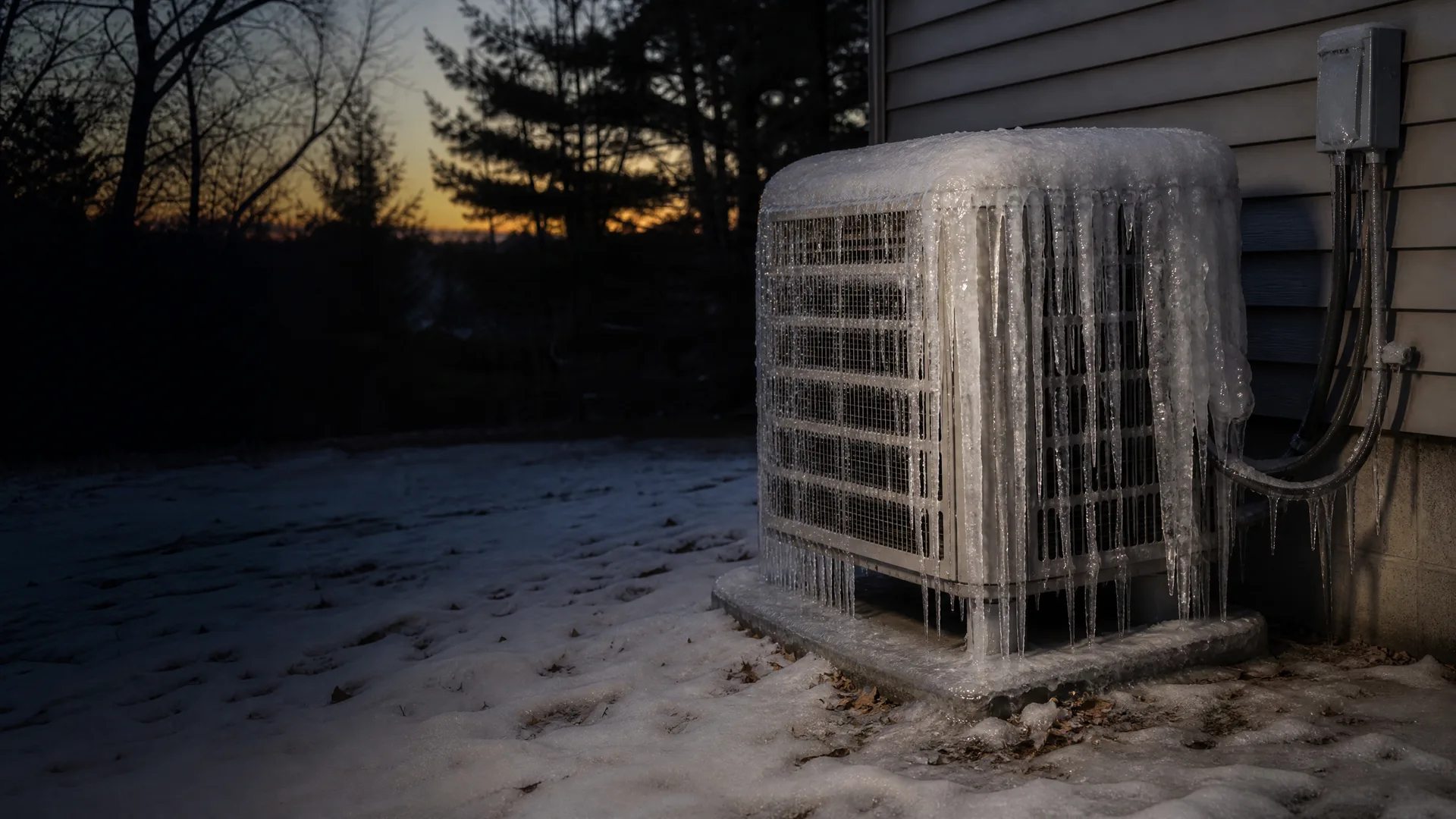
A coil caked like this can't pull heat from the air, so the system runs without actually warming the house.
You go out for the recycling bin before the sun is up and see it from the side yard: the outdoor unit crusted in ice, thick over the coil, a frozen apron spreading across the pad underneath. No hum, no fan turning. Somewhere behind you the house is holding onto whatever heat it has left from overnight. You crouch down and knock a knuckle against the casing and the ice doesn't give at all. It's been cold for days, the kind of Cuyahoga County stretch that doesn't let up at night, and whatever this unit was doing out here while you slept, it wasn't defrosting and it wasn't heating.
A unit stuck like that past dawn usually means the defrost board, the reversing valve, or a sensor that's supposed to call for defrost and isn't, and none of that is something to wait out through a Cuyahoga County cold snap when the backup heat is picking up the slack and the electric bill is the one that shows it. Figuring out which of those it is means getting someone out who works on heat pumps all winter in this county, not just central air in July, because a lot of shops around here still treat heat pumps as a summer machine and guess at the rest. Instead of calling around to find out who actually services them through the winter, describing the ice and the silent fan to each one, then weighing quotes against each other, this goes to one local contractor who already knows what tends to fail on these units when it's cold enough to freeze the yard. You can get back to the house and let them sort out what's actually wrong with the unit sitting out there.
The defrost cycle is keeping up
The system frosts over during the coldest hours, then clears itself when the cycle runs. You might notice the fan pause and a faint smell of warm metal, or steam coming off the unit as the ice melts. Within twenty minutes or so the coil is bare again and the fan is back to turning. The house keeps its temperature through this, maybe with a short dip you'd only catch by watching the thermostat. This is the unit doing what it's built to do in a Cuyahoga County winter. No ice remains once the cycle finishes, and nothing needs to be done about it.
The defrost cycle is losing
The ice doesn't clear. It builds through one cycle, then the next, until the coil is covered and the fan can't turn at all. The house falls behind, calling on backup heat or losing ground overnight. By morning there's a thick shell over the coil, sometimes ice pooled at the base of the unit on the pad below. Something is stopping the defrost from finishing its job, a stuck reversing valve, a failed sensor, low refrigerant. Left alone, it doesn't fix itself. The unit stays frozen until a contractor finds what's keeping it from clearing.
Why does a Cuyahoga County winter push a heat pump this hard?
Winter nights average 23°F
Overnight lows average 23°F in December, January and February, so the outdoor coil spends most of the night pulling heat from air that cold.
Heat runs October through May
Heat runs from October through May here, nearly eight months, so the heat pump and its defrost cycle are working far more than they rest.
Cooling runs June through August
Cooling only runs June through August, so for most of the year this same unit is doing the hard job: making heat out of cold air.
NOAA nClimDiv 1991-2020
A heat pump that defrosts correctly is doing extra work, not failing. It's drawing heat from air that's often below freezing, so some frost and some defrost cycles every night are part of normal operation, not a sign of trouble.
A heat pump that stays frozen has lost that ability. The reversing valve, the defrost control board, or the outdoor fan isn't doing its job, and the ice keeps building instead of clearing, hour after hour, until something else gives out too.
1
Outdoor air chills the coil below freezing, and frost forms on it
2
A sensor or timer tells the system to start a defrost cycle
3
The reversing valve switches the unit into cooling mode briefly
4
Hot refrigerant flows outdoors and melts the frost off the coil
A frozen heat pump means something isn't cycling right.
A little frost on a cold morning is the system doing its job. A thick shell of ice that doesn't clear, a fan that won't turn, a house that keeps losing ground against a Cuyahoga County winter: that's the defrost cycle failing, not the cold beating the equipment. The reversing valve, the sensor, the control board, a low refrigerant charge. One of them isn't doing its part, and the ice is what shows up on the outside.
Finding that part usually means a licensed contractor who can get to the unit, check it against what a working defrost cycle looks like, and tell you which piece failed. You don't have to be the one who figures out which company to call, explains the ice on the coil over the phone, then does it again for a second quote and a third. One request here goes to one licensed Cuyahoga County contractor, and it's free to ask.