A lit brick residential street at dusk showing a row of two-story homes with covered porches and mature trees.

Heat Pump Repair in Sandusky, OH

Tell us about the job

Takes about a minute. No obligation.

RepairHeat PumpErie County, OH
Step 1 of 2

What ZIP code is the job in?

Your heat pump runs hardest in winter, not summer

Erie County is zone 5A. Cool climate. Heating does most of the work here, not cooling. Winter nights average 23°F, so the system logs plenty of hours keeping the house warm. But it's not fighting brutal heat all summer the way units further south have to.


That makes a repair worth doing

A heat pump that hasn't been run ragged by hot summers is usually sound underneath, whatever's acting up now. When something fails on a unit like this, it's usually age or a neglected part, not a system worn out from strain. That's a better starting point for a repair than a guess.

8 months
October through May, your system heats
3 months
June through August, it cools
23°F
the average winter night it heats against
81°F
the average summer afternoon it cools against
Isometric cutaway illustration of a single-story house showing interior ductwork, an indoor air handler and furnace unit, and an outdoor condenser connected by a line, on a white background.
Your system heats October through May and cools June through August.

NOAA nClimDiv, 1991–2020 normals

Your heat pump sits quiet most of September, between cooling and the October start of heat.

October is when a weak part tends to fail, right as the heat pump takes on its biggest job of the year.

Half the homes here were old before your heat pump was even installed

Half the homes here were built by 1968
59 damaging wind events from 2015 to 2024
11 hail events from 2015 to 2024
Ohio power costs more, so a struggling heat pump costs moreElectricity ran 15.99 cents per kilowatthour in 2024. A heat pump that's losing efficiency burns through more of it every month.

A compressor is the heart of the system, and if a tech tells you that's failing, the conversation changes. A failing compressor is expensive to replace on its own, and on an older unit it usually makes more sense to put that money toward a new system instead. Most other failures aren't like that. A capacitor, a contactor, a defrost control board, a fan motor, these are parts that fail on their own schedule, independent of how old the rest of the unit is, and swapping one back out is a normal repair. The honest question isn't just what broke, it's what else is showing wear nearby. A heat pump that's otherwise quiet and only threw one bad part is worth fixing every time.

It's usually worth repairing

It has an easier job here than in most places, so your heat pump is often in decent shape. Repair is usually worth it.

Find a contractor
A white mini-split heat pump outdoor unit mounted on a concrete pad beside a gray-sided house, surrounded by gravel and green shrubs.

The part that's already failing is the one absorbing the extra strain

A heat pump that's struggling still runs. That's the problem. A worn bearing in the fan motor gets hotter the longer it spins. What would've been a quiet motor swap turns into a scorched stator. A failing capacitor makes the compressor pull harder on every start. Each hard start wears the windings down a bit more, until one day it doesn't start at all. Ice on the outdoor coil, the kind a bad defrost board should be clearing, just keeps building. It blocks airflow until the compressor is fighting a block of ice instead of moving heat. None of this gets better by waiting out another night of runtime. The part that's already weak is the one doing the extra work while the decision gets put off. It's usually the first thing to fail completely.

The outdoor unit is running but the house won't warm up

A heat pump in trouble doesn't always go quiet. The outdoor fan can still spin. The indoor blower can still push air. The house still doesn't hold the temperature on the thermostat. When the system is clearly running but not keeping up, something inside isn't doing its job. A reversing valve stuck in the wrong spot, a refrigerant leak, or a compressor that's lost its grip on the work can all look like this from the thermostat.

Air coming out that feels wrong for the setting

In heating mode, air at the vents should feel warm, not just less cold than the room. If it feels barely lukewarm, or cool enough to make you think the system's in the wrong mode, that usually means the heat pump isn't pulling enough heat out of the outdoor air to begin with. That points to the refrigerant side or the compressor, not anything downstream.

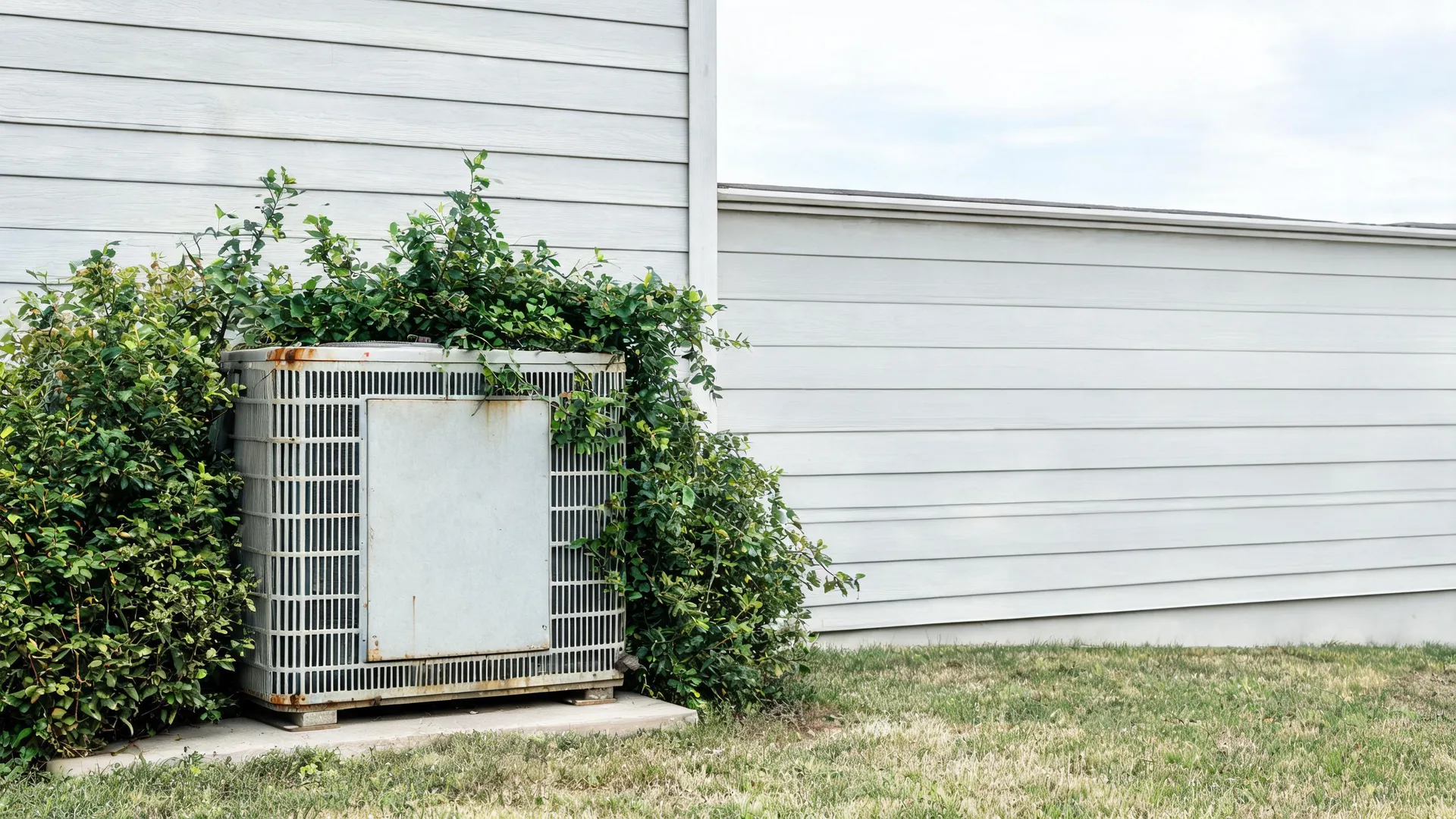
Most heat pump failures are electrical, not mechanical. A capacitor loses its charge over time, and then the compressor or fan motor can't get the kick it needs to start. A contactor's contacts pit and burn from months of opening and closing, until they stop making a clean connection. There's no way to catch these by watching the unit run. They either hold or they don't. Outside, there's a failure that's easier to spot. A condenser coil caked with leaves, grass clippings, or a season of dirt can't move heat right, and the system struggles even though nothing inside is actually broken. Clearing that coil is maintenance, not repair. Worth checking before anyone calls it a bad part.

A diagnostic visit starts outside at the unit, not on the phone. A tech checks refrigerant pressures, reads the amp draw on the compressor and fan motor, and tests the capacitor and contactor under load instead of just eyeballing them. Indoors, the air temperature at the vents gets checked against what the thermostat is calling for. That gap says more than the thermostat display ever will. Error codes on the board get pulled and checked against what the system is actually doing right now, because a board can hold onto a code from weeks ago that isn't today's problem. All of this happens before anything gets opened up or replaced. The point is to find the one part actually causing the trouble, not to start swapping parts and hope something sticks.