An outdoor air conditioning condenser unit mounted on a concrete pad next to a residential house at sunset.

Heat Pump Repair in Portsmouth, OH

Tell us about the job

Takes about a minute. No obligation.

RepairHeat PumpScioto County, OH
Step 1 of 2

What ZIP code is the job in?

October is when weak units show up

The heat pump switches over to heating in October after sitting idle most of the summer. Whatever was already marginal in it, a weak capacitor, a low-level refrigerant leak, a contactor on its way out, tends to fail once the system has to carry a full heating load again.

That timing tells a contractor where to look

A heat pump that struggles in its first weeks of heating usually failed under load, not out of nowhere. That points a contractor toward the parts that get stressed at startup and under steady demand. It narrows down the diagnosis before the contractor even shows up.

7 months
October through April, your system heats
4 months
June through September, it cools
26°F
the average winter night it heats against
85°F
the average summer afternoon it cools against
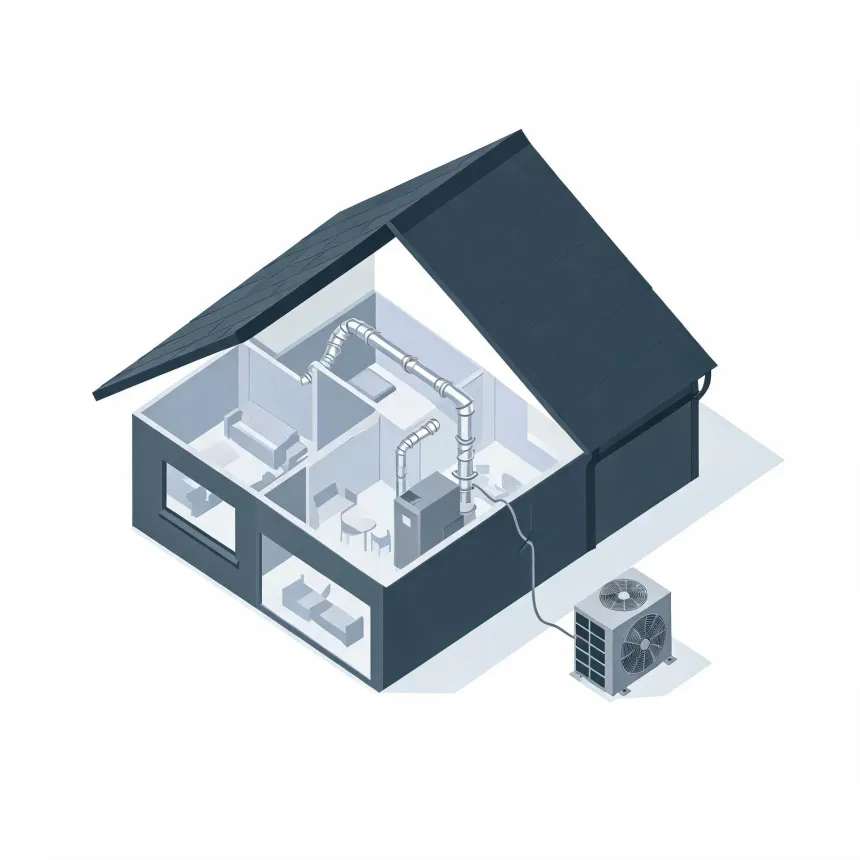
Isometric illustration of a cutaway house showing interior rooms with furniture, a furnace and ductwork, connected by a line to an outdoor condenser unit on the ground outside.
Your system heats October through April and cools June through September.

NOAA nClimDiv, 1991–2020 normals

Scioto County winters average 26°F at night. That's cold, but it's not the kind of deep freeze that puts a heat pump under constant strain.

So if a heat pump is struggling in that range, the cold isn't the real reason. Something else is wearing it down, and that's worth finding.

Scioto County gets its share of rough weather, but that's not why the heat pump failed

134 severe weather events from 2015 to 2024
18% of homes statewide lost power a day or more in 2024
114 damaging wind events from 2015 to 2024

Ohio runs 15.99 cents per kilowatthour as of last year, higher than a lot of the country, and a heat pump leans on electricity for every degree it produces. That rate doesn't change whether the unit is running clean or struggling. A weak capacitor or a contactor losing contact makes the compressor work harder to do the same job, and you pay for that extra work every day it goes unfixed. The cost of waiting shows up on your bill before it shows up as a breakdown. Getting it looked at now costs less than letting it run rough through the winter.

Half the homes in Scioto County were built in 1968 or earlier

A repair call is a good time to ask how much life is left in the system, especially in an older house. That's worth knowing before more money goes into it.

Find a contractor
A man in a dark shirt and work boots carries a canvas tool bag filled with tools up wooden porch steps toward a navy blue front door of a shingled house, with a potted shrub to the right.
A gray outdoor HVAC unit mounted on a concrete pad beside a house with gray lap siding and a stone foundation.

The hours on this unit add up whether the winter was hard or easy

Every hour on that counter is real work, not idling. A heat pump that cycles on and off for years wears out the same way no matter how mild the winters were. The compressor still has to start, run, and stop every time. Starts are harder on a compressor than running is. So a unit with a lot of short cycles can be closer to the end than one that runs long and steady. Age matters too. An older system has way more cycles behind it than a younger one, even if they sat through the same winters. That's part of what gets weighed when looking at a repair. A part failing early in a young system is probably a one-off. The same failure in a system well into its working life is more likely the first of several. That changes whether fixing it is the right call.

It's blowing air that doesn't feel warm enough

A heat pump in heating mode puts out air that feels warm to the hand, not hot like a furnace. Usually it's around body temperature. If the air feels cool, or barely different from room temperature, something in the cycle isn't working. Could be the reversing valve stuck in the wrong position. Could be the system is low on refrigerant.

It's running constantly without ever satisfying the thermostat

A heat pump that cycles on, runs a while, then shuts off is doing its job right. One that runs nonstop and never gets the house to the set temperature is losing somewhere. Maybe airflow is choked off at the coil. Maybe the compressor isn't pulling its weight. Either way, get it looked at before the system wears itself out trying.

Most heat pump failures come down to a handful of parts that just wear out from doing the same job over and over. The capacitor gives the compressor and fan motor the extra push they need to start up. It weakens slowly, and one day it can't deliver that push at all. The contactor is the switch that sends power to the compressor. Its contacts pit and burn with every cycle until they stop making clean contact. That can leave a fan running while the compressor just hums or stays silent. Refrigerant doesn't get used up. If the system's low, it's leaking somewhere, often at a fitting or coil, and that shows up as weak heat before it ever shows up as no heat. The reversing valve fails less often, but when it sticks, the system can't switch between heating and cooling, and the air coming out may not feel like either one. None of this is cold weather wear. It's parts reaching the end of their working life.

A diagnostic visit starts before any panel comes off. A contractor checks what the thermostat is calling for, what the air off the indoor coil feels like, and what the outdoor unit sounds like on startup. Each of those points to a different part of the system. From there it's gauges on the refrigerant lines to check the pressures, and a meter on the capacitor and contactor to see if they're holding the values stamped on them. Low pressure on one side points toward a leak and roughly where it is. A capacitor reading under its rating explains a compressor that hums but won't start. The point of the visit is to find which part stopped doing its job. Not to replace parts until something works.