





A row of dark-sided single-story houses with brown shingled roofs behind a tall trimmed hedge, surrounded by large leafy trees and mown grass under an overcast sky.

Heat Pump Repair in Newark, OH

Tell us about the job

Takes about a minute. No obligation.

RepairHeat PumpLicking County, OH
Step 1 of 2

What ZIP code is the job in?

Most heat pump failures come down to a handful of parts. The reversing valve is one of them. That's what switches the system between heating and cooling. When it sticks, the unit keeps blowing cold air when it should be heating the house. The defrost board is another. It tells the unit when to melt the frost off the outdoor coil in cold weather. If it fails, ice keeps building up until the coil can't pull in heat anymore. A slow refrigerant leak causes the same kind of problem over time. The system runs longer and heats less. Outside, the fan motor and the compressor take the brunt of the weather. If either one wears out, the outdoor unit can't do its job, no matter how good the rest of the system is.

8 months
October through May, your system heats
3 months
June through August, it cools
22°F
the average winter night it heats against
82°F
the average summer afternoon it cools against
Isometric cutaway illustration of a small house showing interior rooms with furniture, an indoor air handler with flexible ducting, and refrigerant lines running to an outdoor condenser unit beside the building.
Your system heats October through May and cools June through August.

NOAA nClimDiv, 1991–2020 normals

Winter nights in Newark average 22°F. That's mild compared to what colder regions ask of a heat pump.

A heat pump here has usually had an easier life. So a repair is more likely worth paying for. It's not a sign to replace the unit.

A heat pump that handled May doesn't mean it's ready for June

Cooling runs June through August
Heat runs October through May
133 damaging wind events from 2015 to 2024

It's usually worth repairing

It has an easier job here than in most places, so your heat pump is often in decent shape. Repair is usually worth it.

Find a contractor
A man seen from behind in a dark shirt and tan pants climbs concrete steps toward a navy blue front door, carrying a canvas tool tote in his right hand, with a large blue planter and shrub to the left.
A white mini-split heat pump outdoor unit mounted on a concrete pad beside a gray-sided house, surrounded by gravel and green shrubs.

Time is what wears it, not the weather

The compressor outside runs the same whether it's day or night. It's not straining against extreme heat or cold. When something fails, it's usually the reversing valve, the defrost board, or the fan motor, and it fails from age, not from being pushed too hard. That matters when deciding whether to fix it. A part that wore out from time, not from strain, is worth replacing on a unit that still has good years left.

A frozen coil gets worse by the hour

If the defrost board stops cycling and ice builds on the outdoor coil, running the heat pump longer just packs more ice on. The coil needs bare metal to pull in heat. Once it's fully coated, the system is heating almost nothing, and the compressor keeps working against it.
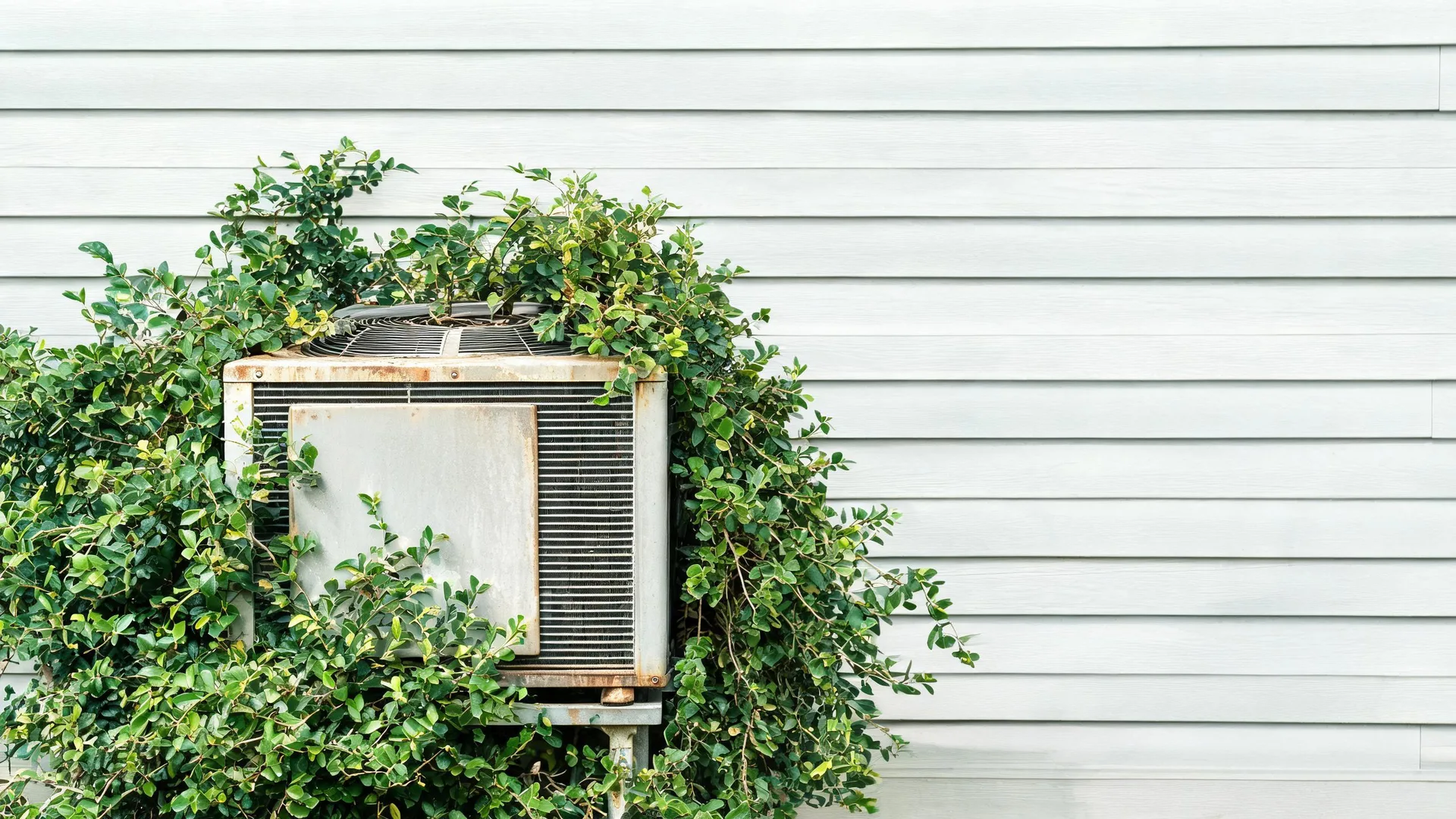
A struggling compressor is the one part that can't take the extra load

Low refrigerant or a failing fan motor makes the compressor run longer to make up for the rest of the system. The compressor is the heart of the outdoor unit. If something else is already making its job harder, it's the part most likely to burn out.

Check the thermostat first. Make sure it's set to heat, and the set point is actually above room temperature. A setting bumped by accident looks exactly like a broken unit. Go outside and look at the coil. If it's coated in ice or frost, switch the system off at the thermostat. Let it sit so it's not running against a blocked coil. Watch the outdoor fan while the system runs. If the fan isn't spinning but the compressor is humming, don't try to fix that. Just tell the tech when they get there. Inside, pull the air filter and hold it up to a light. Can't see light through it? Swap it before calling anyone. A clogged filter can look like a much bigger problem. Check the breaker panel too. A tripped breaker that won't reset means an electrical fault. Stop testing and get someone out.

Age matters less than what's actually failing. A heat pump with a bad capacitor or a failed contactor is still worth fixing, because those parts are inexpensive to replace and don't say anything about the rest of the unit. What changes the math is the compressor. If the compressor itself has failed, that's most of the cost of a new outdoor unit, and paying for it on an older system doesn't make sense. A tech can tell you which situation you're in before any work starts, not after. Ask directly whether the broken part is isolated or whether it's a symptom of the compressor or coil giving out, because that answer is what should decide repair versus replacement, not the unit's age by itself.