





Dark-painted single-story houses with gray shingle roofs behind a trimmed green hedge and mown lawn, surrounded by leafy trees under an overcast sky.

Heat Pump Repair in Delaware, OH

Tell us about the job

Takes about a minute. No obligation.

RepairHeat PumpDelaware County, OH
Step 1 of 2

What ZIP code is the job in?

Half the homes in Delaware County were built in 2000 or later. If yours is one of them, your heat pump is probably newer too, especially if it's the original system. A unit installed in the last couple decades still has plenty of working life in it, and a breakdown now is more likely a specific part failing than the whole system giving out. That changes the math on repair. Fixing a newer unit is usually the right call, because you're not propping up equipment that's already near the end.

8 months
October through May, your system heats
3 months
June through August, it cools
23°F
the average winter night it heats against
83°F
the average summer afternoon it cools against
Isometric cutaway illustration of a small house showing ducted air distribution, an indoor air handler, and an outdoor condenser unit connected by lines, with a sofa and bed in the rooms.
Your system heats October through May and cools June through August.

NOAA nClimDiv, 1991–2020 normals

Delaware County summers run humid but the dew point averages 62°F, not the heavy air you get further south.

A heat pump here isn't fighting that load year after year, so a repair usually brings back a machine with plenty of life left.

Electricity here costs 17.65 cents a kilowatt-hour, so a heat pump running wrong is an expensive thing to leave alone

Power here costs 17.65 cents per kilowatt-hour
Climate zone 5A
Cooling runs June through August
Heat pump trouble shows up fastest right when the season startsHeat here runs October through May, so a weak part usually fails in the first cold snap of fall.

A heat pump that's short cycling, running constantly, or blowing air that's not quite warm or cool enough is drawing power the whole time it does it. A stuck reversing valve or a failing capacitor makes the system work harder to do the same job, and you pay for that extra work every day it runs. Power here already costs more than in most places, so that extra draw shows up on the bill fast. Waiting on it doesn't save you anything. Get a contractor out to look at it soon, before it runs like that any longer than it has to.

Your heat pump is probably still young. Get it fixed, not replaced.

Get a worn part fixed now and the system keeps going for years, not months. A repair is money put into equipment that still has a long life ahead of it.

Find a contractor
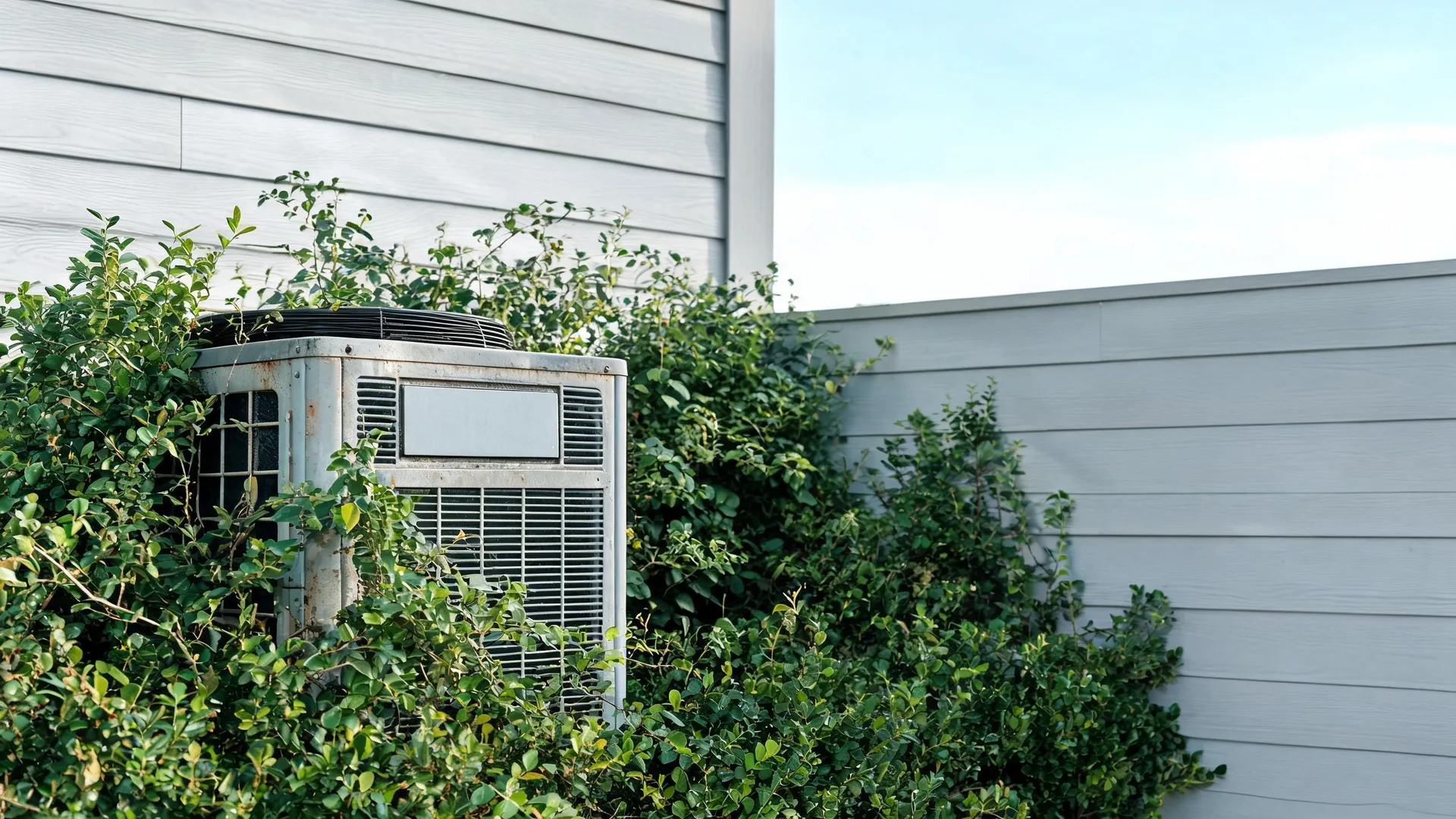
A gray heat pump condenser unit mounted on a concrete pad against the gray lap-siding exterior wall of a house.

Light duty, year after year

Since the system isn't fighting heavy humidity year after year, a repair now just has to deal with whatever part failed, not a unit that's been run down by years of hard duty. Check the data plate for the install year. A machine from the last couple decades, running in a climate this easy on it, still has a long stretch of years ahead once the bad part is replaced.

What you can check yourself

Look at the outdoor unit first. Ice built up on the coil or the lines means something is off, whether it's low refrigerant or a defrost control that isn't cycling right. Check that nothing is blocking airflow around the unit, no leaves, no snow piled against it. Inside, swap the air filter if it's dirty. A clogged filter starves the system of airflow and can make it run constantly without ever catching up. Check the thermostat batteries and the breaker panel too. A tripped breaker or a thermostat stuck on the wrong setting looks exactly like a failed unit but costs nothing to fix.
What to leave alone

Don't open the outdoor unit's refrigerant lines or touch the electrical panel inside it. Refrigerant needs to be handled by someone licensed to recover and recharge it, and the capacitor in there holds a charge even with the power off. If the system is making a grinding or screeching noise, or tripping the breaker repeatedly, turn it off at the thermostat and leave it off. Running a heat pump through a mechanical failure usually turns a one-part repair into a multi-part one.

A heat pump usually tells you something is wrong before it quits outright. Air coming out lukewarm, neither warm enough in winter nor cool enough in summer, often means the reversing valve is stuck or the charge is low. If it's cycling on and off every few minutes instead of running a full stretch, a sensor or a failing capacitor is probably cutting it short. Listen for noise too. A click when it tries to start and nothing after, a hum with no fan movement, or a hard clunk when it switches between heating and cooling all point to a part giving out, not the whole unit. Ice forming on the outdoor coil outside of a normal defrost cycle means the system isn't shedding heat the way it should. Any of these on their own is usually a single part. Ignored, they tend to pull other parts down with them.

Repair versus replacement comes down to what actually failed, not just that something did. A capacitor, a contactor, a defrost control board, a blower motor: these fail on their own, and swapping one out brings the whole system back to normal. None of them means the rest of the unit is wearing out. The compressor is different. It's the one part that's expensive to replace and hard to justify replacing on its own, so when a tech tells you the compressor is going, that's the real fork in the road. Everything else is a repair question. The compressor is a keep-or-walk-away question. If a contractor can point to the specific part that quit, and it isn't the compressor, fixing it is almost always the straightforward move.