A nighttime view of a tree-lined residential street with illuminated two-story brick houses and street lamps.

Heat Pump Installation in New Philadelphia, OH

Tell us about the job

Takes about a minute. No obligation.

New system or replacementHeat PumpTuscarawas County, OH
Step 1 of 2

What ZIP code is the job in?

The size of the unit has to match the house

Sizing a heat pump means running a load calculation. That looks at square footage, insulation, window count, ceiling height. Not just whatever size is being replaced. A unit too big will short cycle and never pull the moisture out of the air. One too small runs all the time and leans hard on backup heat during the coldest weeks.


What's already there changes the job

If the ductwork is sound and the electrical panel has room for a new circuit, installation is straightforward. If the ducts are undersized, the panel's full, or the line set needs rerouting, that work gets added before the heat pump itself goes in.

8 months
October through May, your system heats
3 months
June through August, it cools
22°F
the average winter night it heats against
82°F
the average summer afternoon it cools against
Isometric cutaway illustration of a small house showing interior ductwork and an air handler connected by lines to an outdoor condenser unit on a pad beside the building.
Your system heats October through May and cools June through August.

NOAA nClimDiv, 1991–2020 normals

A heat pump in New Philadelphia gets its first real test in October, once the heat starts running.

Get the new system in before September. That gives it a full month of mild weather to prove itself before it has to carry the house.

Half the homes here were built before heat pumps were standard equipment

Half the homes here were built by 1971
Climate zone 5A
Power costs 15.99 cents a kWh statewide
Most of this county heats with gas63.7% of homes in Tuscarawas County heat with utility gas. That's more than every other fuel put together.

A heat pump in Tuscarawas County spends most of its time on heating, since winters here run cold enough that the overnight average sits at 22°F across December, January and February. That's steady, predictable work, not the kind of swing-season strain that wears a system out early. Zone 5A means the load is real but not extreme, so a well-matched heat pump handles it without leaning on backup heat every week. You don't need the highest efficiency model on the lot to get through a winter like this one. What tends to fail here is age and neglect, a unit that never got serviced or one sized wrong from the start, not a machine run into the ground by the climate itself.

Any heat pump installed here has to meet the zone 5A minimum

Zone 5A sets the floor for this area. A split-system heat pump has to hit at least 14.3 SEER2 for cooling and 7.5 HSPF2 for heating. Meet those numbers this year and it also qualifies for the federal tax credit. Start the form above to find a contractor who installs to that standard.

Find a contractor
A man in a cap, navy long-sleeve shirt and tan work pants carries a canvas tool bag up steps toward a dark front door, with a potted shrub beside the porch.
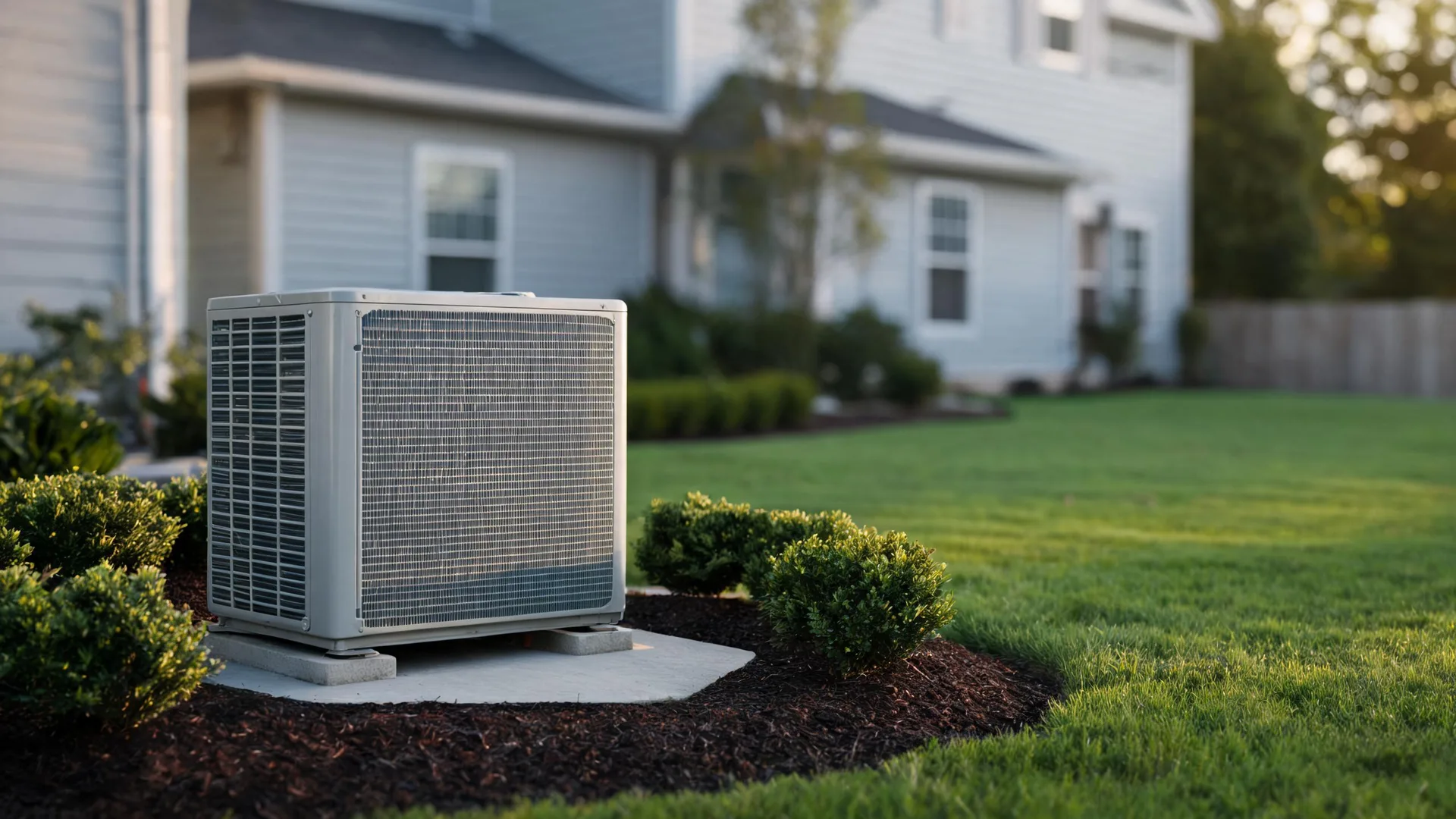
A gray heat pump outdoor unit mounted on a concrete pad next to a residential house with lap siding and stone accents.

The old unit doesn't stay

Replacing a heat pump doesn't leave an empty slab for long. The old condenser gets disconnected and hauled off. The refrigerant gets recovered first, since it can't legally be vented into the air. If the furnace or air handler is getting replaced too, that comes out at the same time, so the new coil has a clean spot to sit. The line set usually gets replaced instead of reused. Old copper can hold contamination that damages a new compressor. The old thermostat comes down too. The new one gets wired fresh, not patched into old low-voltage wiring that might not match.

Ohio electricity runs 15.99 cents a kilowatt-hour

Ohio homes paid that average rate in 2024. A heat pump in New Philadelphia draws on that rate for every month it heats and cools, so the rate itself sets how much a given month of runtime costs before efficiency even enters into it.

Efficiency is what you control against that rate

The electric rate is fixed, but how much a heat pump needs to produce a degree of heat is not. Two systems sized the same for the same house can pull different amounts of power to do the same job, and at Ohio's rate that difference shows up on the meter every month, not just on the spec sheet.

SEER2 and HSPF2 are ratios, not fixed amounts of cooling or heat. SEER2 measures cooling output against the electricity it takes to produce it over a season, and HSPF2 does the same for heating. A higher number means the compressor is moving more heat per unit of power, not that the unit is bigger or stronger. Heat pumps rated for the same house can carry identical capacity and still land in different spots on that scale, because the difference sits in the compressor staging and coil design, not the tonnage. That rating isn't a guarantee either. A correctly sized, well-installed unit at the standard rating will outperform an oversized or poorly charged system carrying a premium rating on the label.

Installation day starts with the old equipment coming out. Then the new condenser goes on its pad, and the air handler or coil goes in wherever it sits indoors. The line set gets run and connected. Once both ends are sealed, the system gets evacuated with a vacuum pump to pull out moisture and air before any refrigerant goes in. That step matters more than people think. Trapped moisture turns to acid inside the line and wears at the compressor from day one. After charging, refrigerant levels get checked against the manufacturer's spec, not by feel. The system runs in both heating and cooling to confirm it's moving air the way the load calculation said it should. The new thermostat gets programmed before anyone leaves. It's set up to run the heat pump as the primary source, with backup heat staged behind it, not ahead of it.