





A row of dark gray gabled houses behind a trimmed hedge and mowed lawn, framed by large leafy trees under an overcast sky.

Furnace Maintenance in Warren, OH

Tell us about the job

Takes about a minute. No obligation.

Tune-up, service, or cleaningFurnace or heatingTrumbull County, OH
Step 1 of 2

What ZIP code is the job in?

Trumbull County has logged 182 severe weather events between 2015 and 2024. Damaging wind caused 143 of those, and the county also saw 9 tornadoes and 21 hail events in that span. A furnace itself sits indoors, away from the wind and hail, but the power that runs it doesn't always hold up. Close to a fifth of Ohio households went at least a full day without power in 2024. A gas furnace still needs electricity to run its ignition and blower, so when the lines go down, the fuel behind it doesn't matter. A tune-up is the time to find out if yours is ready for that, not during a storm.

Almost 8 in 10 homes in Trumbull County heat with gas.

A gas furnace has a burner and a vent system that need checking every year, not just a new filter.

Half the homes in Trumbull County were built in 1964 or earlier

Half the homes here were built by 1964
Climate zone 5A
Heat runs October through May
Get it checked in September, before heat season startsFurnaces here start running in October and stay on through May.

Furnaces here run about eight months a year, October through May. That is most of the calendar, and it puts real hours on the igniter, the blower motor, the bearings inside it. A furnace that only ran a few months could hide a weak part for years. One running eight does not get that luxury. Whatever is starting to wear shows up early into the season, usually on the first hard cold snap when the furnace is working its hardest. A tune-up before October is what catches that part while it still has some life left in it, instead of after it quits.

Have it checked before the next outage, not during one

A tune-up includes a check of the furnace's wiring and connections, the parts a power blink can jolt. If an outage knocked out power this year, or if the system has never been checked since one, this is when to find out if anything needs attention before the next storm season.

Find a contractor
A man in a dark long-sleeve shirt and tan work pants, seen from behind, carries a worn canvas tool bag up steps toward a navy blue front door of a gray clapboard house, with a large blue planter and shrub to the right.
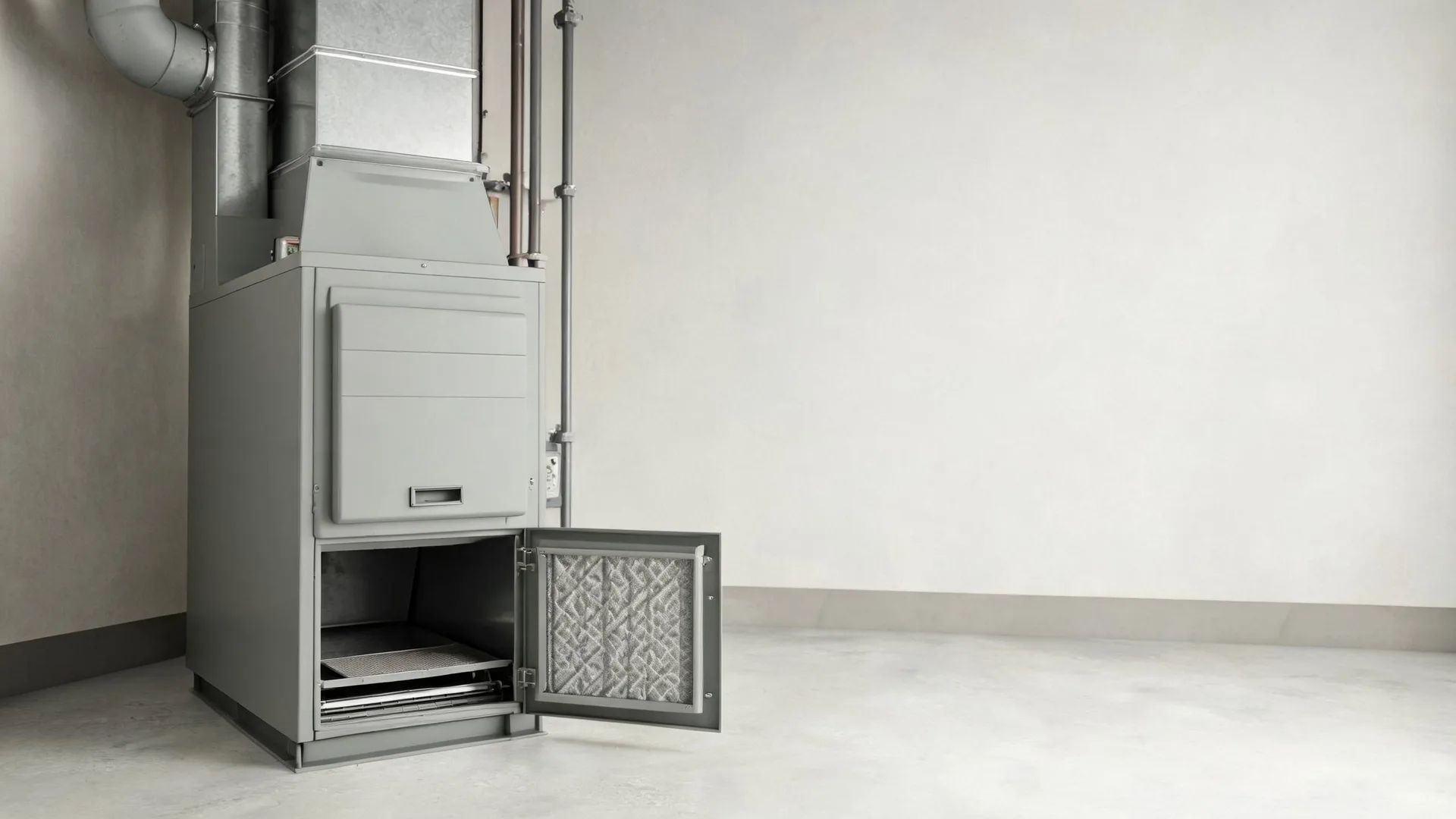
A gray gas furnace with attached ductwork and piping installed in an unfinished concrete basement.

Eight months of runtime, one window to check it

Eight months of runtime means eight months where a loose wire or a worn part gets the chance to act up. Before October is when there's still time to deal with it. Once the furnace is running every day through a long winter, a technician checking it over has less room to catch something before it becomes a no-heat call.

A full tune-up takes the cabinet apart

A thorough check means the technician pulls the blower compartment open, not just the front panel. The flame sensor gets cleaned or tested, not glanced at. The heat exchanger gets inspected for cracks, because a cracked one can leak exhaust into the air a furnace is supposed to be warming. A quick visit skips straight to the filter and calls it done.
Ask what gets measured, not just looked at

A real tune-up checks gas pressure at the manifold and the temperature rise across the heat exchanger, both with actual readings written down. Static pressure in the ductwork gets tested too, since a blower working against too much resistance wears out early. If nobody takes a reading and writes down a number, nothing was actually measured.

A furnace filter is the first thing the air crosses and the easiest to forget. Once it loads up with dust, the blower has to pull harder to push air through it, and a blower working that hard runs hotter and wears faster. On the other side, the heat exchanger has fins and surfaces that shed a layer of dust over time, and when they're coated the furnace can't move heat into the air as well as it's built to. A dirty filter is the usual reason a heat exchanger gets dirty too, since whatever the filter doesn't stop ends up coating everything downstream. A furnace doesn't have a drain line the way a cooling coil does, so there's no standing water to worry about on the heating side. The filter is the one part in this chain a homeowner can actually check without opening a panel, and a clean one does most of the work of keeping the rest clean behind it.

A furnace in a house built in 1964 or earlier has been through decades of parts wearing down a little at a time. The furnace itself might be newer than the house, but there's no way to know that from the street. A yearly check is how a technician finds out what's actually behind the panel, instead of guessing from the home's age. A worn igniter or a cracked heat exchanger gets caught while it's still a small fix, before it leaves the house without heat on the coldest night of the year. A system installed more recently can go a season without a look and probably be fine. One that's been running since the house was young doesn't get that same benefit of the doubt.