



A quiet suburban street at twilight featuring two-story brick homes with illuminated windows and large trees lining the sidewalk.

Furnace Maintenance in New Philadelphia, OH

Tell us about the job

Takes about a minute. No obligation.

Tune-up, service, or cleaningFurnace or heatingTuscarawas County, OH
Step 1 of 2

What ZIP code is the job in?

Tuscarawas County logged 172 severe weather events between 2015 and 2024. Most of that was wind, 124 events, with 38 hail events mixed in and a couple of tornadoes touching down. Wind and hail hit the outdoor parts of a heating and cooling system hardest, denting housings and driving debris into places it doesn't belong. The county also saw 8 winter storms in that stretch, the kind that bring down lines along with the snow and ice. Statewide, 18% of Ohio households lost power for a day or more in 2024. A furnace with a cracked igniter or a dirty flame sensor might limp along most winters. It won't when the power's been out and the house is already cold.

Gas heats 63.7 percent of the homes in Tuscarawas County.

That burner, its vent and its safety controls need a real check every year, not just a new filter.

Half these furnaces are older than the house's first owner would guess

Half the homes here were built by 1971
Climate zone 5A
Heat runs October through May
Book the tune-up in September, before the furnace has to workFurnace season here runs October through May.

A yearly check matters more once a furnace has been in the house a while, and here that's the normal case. Half the homes in Tuscarawas County were built in 1971 or earlier. A furnace doesn't last as long as the house does, so in a lot of these homes the unit running now isn't the first one, and nobody's kept track of exactly how old it is. That's the point of the yearly check. A technician looking at the burner, the heat exchanger and the safety controls once a year catches the crack or the worn part while it's still a small fix, instead of finding out on the coldest night of the year.

Have the furnace checked before the next storm takes the power with it

A tune-up catches the cracked igniter or the worn safety control now, while the power's on and the house is warm. That's the time to find it, not during the next outage.

Find a contractor
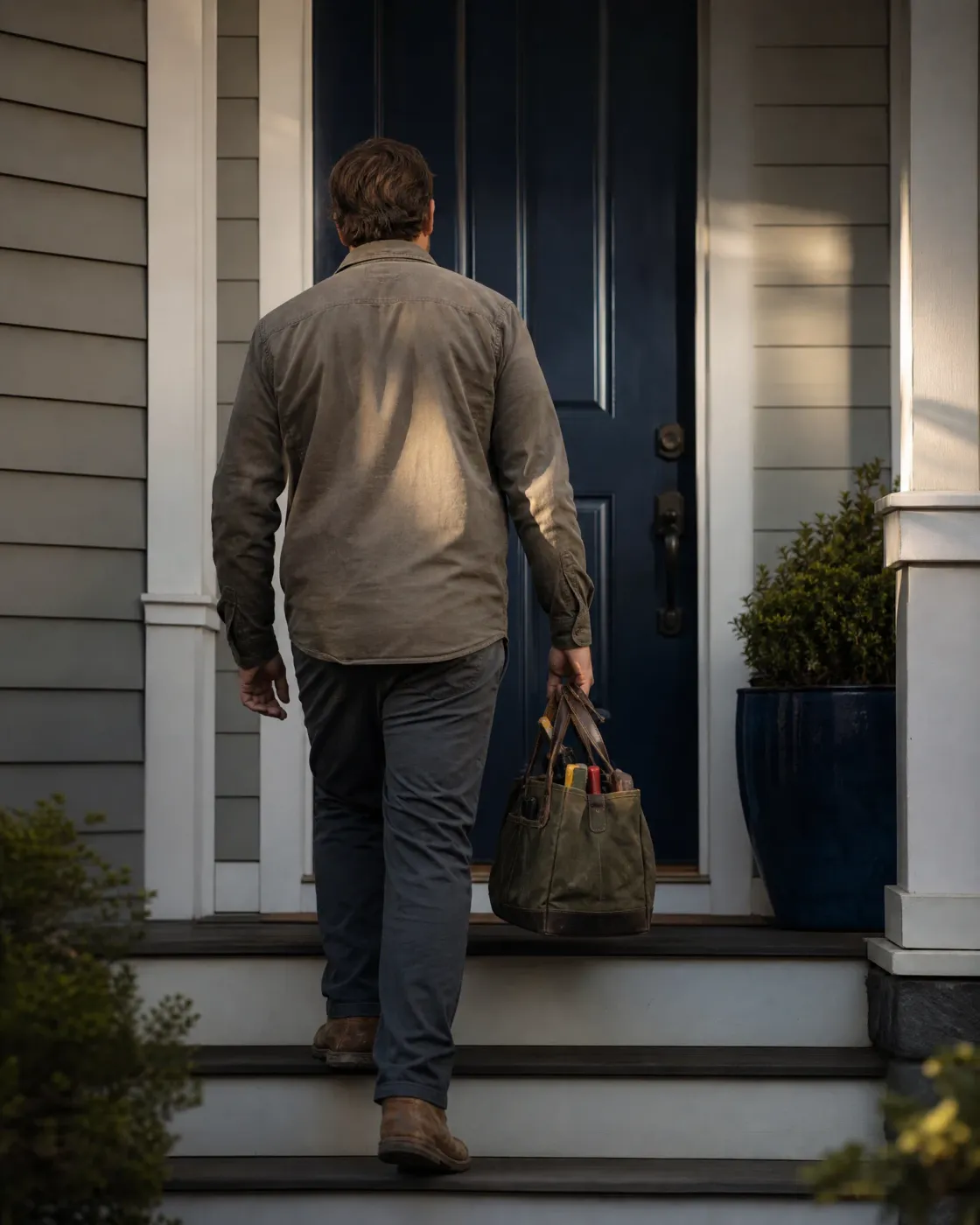
A man in a faded olive work shirt and dark trousers climbs porch steps toward a navy front door, carrying a green canvas tool bag in his right hand, with a potted shrub in a blue planter beside the door.
A gas furnace with attached ductwork, gas piping, and condensate lines installed in a concrete-block basement.

What you can check yourself, and what to leave shut

Between visits, the filter is the one thing worth checking yourself. Pull it out, hold it to the light, and if you can't see through it, swap it in. A clogged filter starves the burner of airflow and makes the heat exchanger work harder than it should. Keep the area around the furnace clear too. Boxes, bedding, anything stacked against the cabinet blocks the return air it needs to breathe. Look at the vent pipe where it runs outside and make sure nothing is nesting in it or packed against the hood. If the flame behind the sight glass burns anything but steady blue, or the furnace is making a noise it didn't make last month, that's not a wait and see. Everything past the filter and the vent, the igniter, the flame sensor, the heat exchanger, belongs to a technician. Opening the cabinet to look at those parts yourself does more harm than good.

A furnace that still lights can still be failing

A furnace can run every day and still be in trouble. Short cycling, a burner flame that's yellow instead of steady blue, a delay before ignition, these are signs of a system working around a problem instead of running clean. Left alone, the part doing the struggling usually fails the rest of the way on its own schedule, not a convenient one.

A tune-up catches what a glance can't

A technician checks things a homeowner has no way to check: gas pressure, the condition of the heat exchanger, whether the flame sensor is reading properly, whether the blower motor is drawing more amperage than it should. None of that shows up from across the room. Catching a weak part during a scheduled visit means it gets fixed on a day of your choosing, not on the night the furnace decides it's done.

A heat exchanger can carry a crack too small to see and still let a furnace run every day without complaint. From across the room everything looks fine. Up close, with the burners pulled and a light behind the metal, that same crack shows up right away. That's the one most worth catching, since a cracked exchanger can let combustion gas mix into the air moving through the house. A technician also checks the pressure switch and the limit switch, the two controls that shut the furnace down if something downstream isn't right, and makes sure each one trips when it's supposed to and not before. Wiring connections get checked too. A screw that's backed out a quarter turn behind the panel can cause a short cycle or a no start, and it never shows itself until it does.

A tune-up starts at the thermostat call and follows the furnace through its own startup sequence, the same one it runs every time it fires. The igniter has to glow hot enough and long enough to light the burners cleanly, and a technician watches that happen rather than taking it on faith. The burners themselves get pulled and cleaned, since a burner clogged with dust or lint burns unevenly and throws a flame that isn't the steady blue it should be. The blower gets checked too, the wheel especially, because a blower wheel caked with dust moves less air without ever slowing down in a way you'd notice. Combustion is tested with the panel on and the furnace actually running, not guessed at from the nameplate. Every control that's supposed to shut the furnace down safely gets tested on purpose, so it's known to work before the night it's needed.