Why heat pumps struggle in sticky Lucas County summers

RepairHeat PumpLucas County, OH
Step 1 of 2

What ZIP code is the job in?

Why does my heat pump struggle to keep up in summer here?

Lucas County summers don't just get hot, they get sticky, and a heat pump that cooled the house fine in a dry spell can suddenly feel like it's not keeping up when the air turns heavy. You want to know if something's wrong with the unit or if this is just what humid air does to it.

It's working harder because it has to pull moisture out of the air, not just cool it

A heat pump cools your house by moving heat outside, and it pulls humidity out along the way. On a muggy day it has to move more moisture to get the same drop in temperature, so it runs longer and the house can still feel damp even when the thermostat hits its setting. If the unit is low on refrigerant or the coil is dirty, that moisture removal suffers first, before the temperature itself seems off. That's often why a heat pump feels like it's struggling here even though the numbers on the thermostat look fine. A system that's clean and properly charged handles Lucas County humidity without much trouble.

A gray outdoor air conditioning condenser unit on a concrete pad beside a house with horizontal siding, next to a green lawn and a plain light-colored wall.

Moisture does the real work

A heat pump cools your house by pulling heat out of the air, and pulling moisture out along with it. When the outside air is heavy with humidity, the system has to work through more of that moisture load before the house feels dry and comfortable. The thermostat might show the temperature you set, but the air still feels damp because the unit is behind on pulling moisture out, not just heat.

A white outdoor heat pump unit on a concrete pad beside a plain light wall, with gravel and mowed grass in front.

Refrigerant charge matters more here

A heat pump running low on refrigerant can still blow cold air, but it loses its ability to wring moisture out of the air long before it loses its ability to cool. In a dry climate that might go unnoticed for a season. In Lucas County, a system even slightly low on charge shows it fast, because there's more moisture in the air for it to fall behind on.

Is your house staying cool but still feeling damp?

You set the thermostat to 72 and the house gets there, but it doesn't feel like it. The air feels heavy. Floors feel clammy. Windows fog up in the morning. The system runs longer than it used to, cycling on and off more through the afternoon, and the outdoor unit sounds like it's working harder than it should. Upstairs rooms lag behind the rest of the house. If this goes on through the summer, that extra moisture sitting in the house can turn into a musty smell, or worse, mold starting in closets and corners that don't get much air. None of that means the system is broken. It means it's not pulling out the moisture it should be.

A gray outdoor condenser unit on a concrete pad beside a house with horizontal lap siding, with a wall-mounted disconnect box, conduit and insulated refrigerant lines, a shrub at left and gravel at right.

Running as it should

This is a heat pump keeping pace. It cycles on, pulls the heat and the moisture out of the air, and shuts off again. The pad is clean, the lines are intact, and the disconnect box is doing nothing more than sitting there. On a sticky August day, this unit still catches up.

An outdoor condenser unit on a concrete pad beside a horizontal-sided house, with insulated refrigerant lines running to a wall-mounted box, surrounded by bare dirt.

Falling behind

This one has been through a lot of Lucas County summers. The cabinet shows weathering, and age like this often comes with a coil that can't shed heat as well as it used to. On a humid day it may run longer and still leave the house feeling damp, especially if nobody's checked it in a while.

Running Longer vs Actually Failing

Still working hard

  • The unit cycles on and off more than it used to, but it still reaches 72 by evening and holds it overnight.
  • Outdoor coil stays free of ice and the air coming out of the vents is cold, just slower to catch up on the muggiest days.
  • Indoor humidity sits a little high but the house is tolerable once the sun goes down and the load drops off.
  • A system in this state is working through a heavy moisture load, not breaking down under it.

Actually failing

  • The thermostat reads 72 but the room never feels like it, even after the system has run for hours straight.
  • Ice forms on the outdoor unit or the indoor coil, which points to low refrigerant or restricted airflow rather than just humidity.
  • The system short cycles, shutting off after a few minutes and starting again, instead of running a long steady stretch.
  • Water pools near the indoor unit or the drain line backs up, which has nothing to do with how sticky the air is outside.
A dimly lit bedroom at dusk with a made bed, a table lamp on a nightstand, and a condensation-covered sash window with a dark curtain.

It's past midnight and you're still on top of the sheets. The thermostat says 72, same as it's said all evening, but the room doesn't feel like 72. The sheets stuck to your back an hour ago and you kicked them off. Now they're damp and bunched at the foot of the bed. The window above the dresser has fogged up at the edges, the way it does on the heaviest nights, and you can hear the outdoor unit still running, same steady hum it's had since dinner. You roll over, flip the pillow to the cool side. Somewhere down the hall a door creaks. The air conditioner hasn't stopped and hasn't failed. It just hasn't caught up.
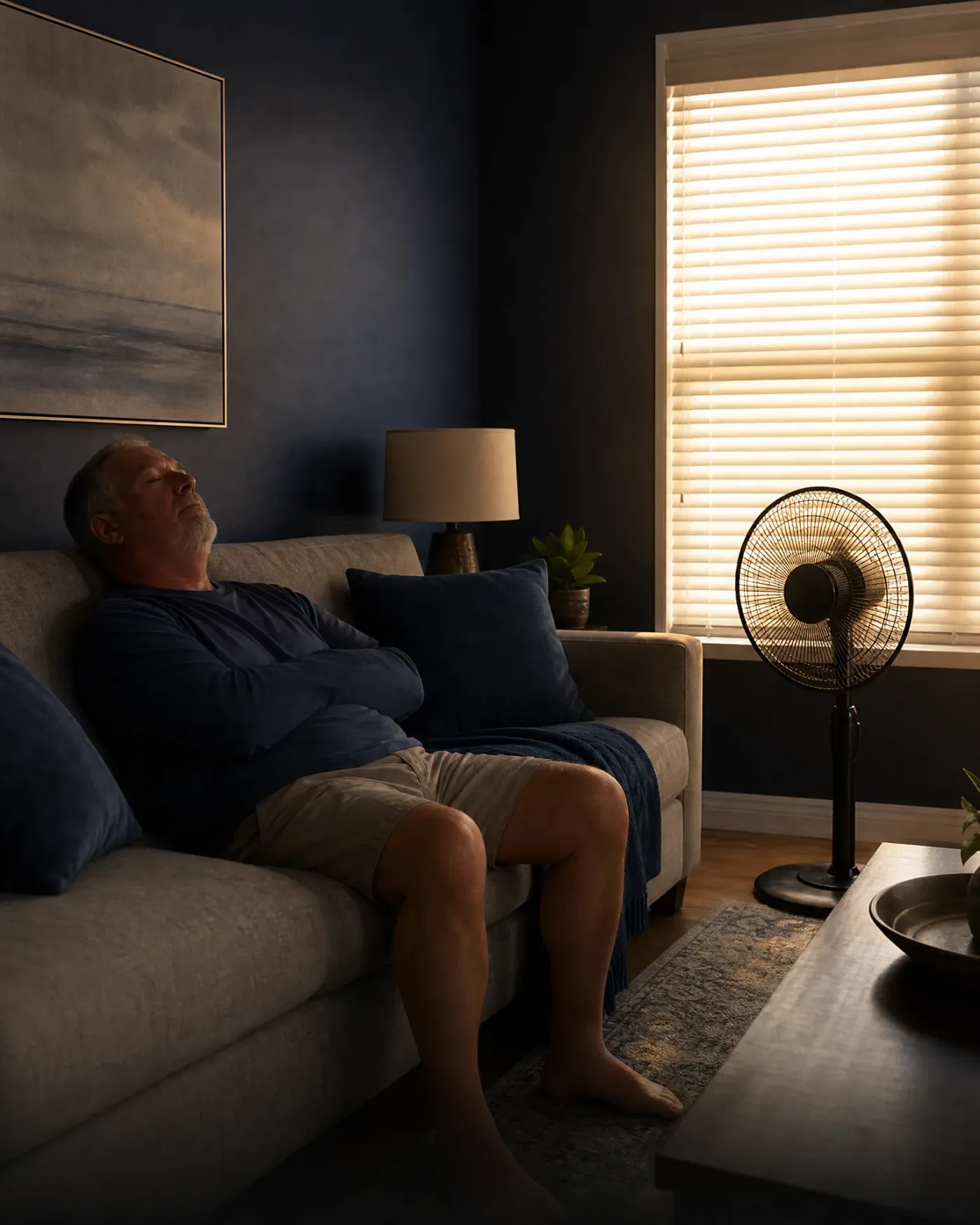

Power here costs 16.51 cents per kilowatt-hour

At 16.51 cents a kilowatt-hour, every extra hour your heat pump runs on a sticky night shows up on the bill fast. A unit that's struggling to pull moisture out of thick air isn't just working harder, it's running longer to get there, and that time adds up at this rate.

EIA-861 2025

A woman with long wavy brown hair in a grey ribbed sweater sits on a couch indoors, looking toward a window, with a potted palm-like plant and fireplace behind her.
A woman with long brown hair wearing a green V-neck top and beige cardigan sits on a light sofa, looking off to the side, with a dining table, lamp and framed picture in the background.
A woman with long dark hair in a cream knit sweater sits on a beige sofa indoors, looking toward a bright window with a houseplant and framed picture in the background.
A smiling woman with dark hair in an updo, wearing a gray ribbed turtleneck sweater, sits on a light sofa in a living room and looks off to the side.

Get your heat pump to the right pro

Skip searching for a heat pump pro and answer a few questions instead.

Sending the form costs nothing.

Call now, while the system still reaches 72 overnight and the coil stays free of ice. A repair at this stage is usually smaller work.

Wait, and you risk a hot stretch where the unit can't keep up at all, and then you're searching for a contractor, calling around, and explaining the problem on the worst night to do it.

How many months is your heat pump actually working here?

  • Winter nights average 22°F

    Winter nights here average 22°F, so your heat pump leans on backup heat for the coldest stretch of the year, not just the mild days.

  • Heat runs October through May

    Eight months of heat means the system barely gets a break before it has to switch over and start pulling moisture out of thick summer air.

  • Cooling runs June through August

    Three months of cooling isn't long, but it's the stretch where sticky air pushes your heat pump hardest, right when you need it most.

NOAA nClimDiv 1991-2020

A gray outdoor condenser unit sits on a concrete pad against a house wall with horizontal siding above a stone veneer base, with an electrical disconnect box and conduit on the wall and a leafy shrub in mulch to the left.
A clean pad, intact lines, and a disconnect box with nothing to do, the signs of a heat pump keeping up with the humidity.
An outdoor air conditioner condenser unit on a concrete pad beside a house with horizontal siding above a concrete block foundation, with insulated refrigerant lines and a vertical white pipe on the wall.
Refrigerant lines running along a weathered foundation are worth a look if the house feels damp no matter what the thermostat reads.

Cooling the air and drying it out are two separate jobs, and a heat pump does both at once through the same part: the indoor coil. Refrigerant runs cold through that coil, cold enough that humidity in the air condenses on it the same way water beads on a cold glass. That water has to go somewhere. It drips into a pan, then down a drain line, and if that line is clogged, the water backs up and some units shut themselves off rather than overflow into the house. The blower matters too. Air has to move across the coil slowly enough for moisture to actually collect there, not just long enough to knock a few degrees off the temperature. A coil that's dirty, or a system that's short on refrigerant, can still cool the air some. It just can't pull the moisture out of it, which is why the house can hit 72 on the thermostat and still feel wet.

How a heat pump actually removes humidity

  • If the condensate line clogs, water backs up and can trip a float switch that shuts the whole system off.
An outdoor air conditioning condenser unit with dusty coils sits on a concrete pad against light horizontal siding, with an electrical disconnect box and refrigerant lines on the wall and a shrub and mulch at left.
Before you get your heat pump repair
A gray outdoor condenser unit sits on a concrete pad beside a house with horizontal lap siding, with a wall-mounted disconnect box and refrigerant lines, mulched beds and a shrub nearby, and a concrete walkway in the foreground.
After you get your heat pump repair

What the sticky air tells you

  • A heat pump that runs long and still leaves the air feeling damp is working, just not keeping up with the moisture load.
  • Ice on the outdoor coil or a clogged condensate line points to a repair, not a system that's simply undersized.
  • The longer a struggling unit runs on sticky nights, the more it shows up on the power bill at 16.51 cents a kilowatt-hour.
  • Catching it while the house still reaches 72 overnight usually means smaller work than waiting for a stretch where it can't.

A heat pump in Lucas County has two jobs every summer day, cooling the air and pulling the moisture out of it, and when the house feels damp at 72 that second job is falling behind. That's not a mystery and it's not something you have to live with through August. It's a sign worth checking, whether that's a coil icing up, a condensate line backing up, or a system running long cycles without catching up on the humidity. The facts point one way: a unit that still hits its temperature but leaves the air heavy is usually a repair, not a rebuild. Left alone, it tends to get worse before a stretch of hot, sticky weather, right when you need it most. Caught early, it's often smaller work.

What usually eats the time isn't the repair itself, it's getting to someone who can do it. Finding a contractor, calling a few, explaining the clammy air and the coil and the cycling all over again to each one, then sitting with quotes trying to compare them. That's the part that doesn't need to fall on you. You already know what your house feels like at 72 when it isn't really 72. The next step is getting that in front of someone who can look at the system itself and tell you what's actually going on with it.

A living room corner with a beige upholstered sofa, cushion and knit throw, a potted green plant in a woven basket, a framed botanical print on a taupe wall, and a window with foliage outside.
Sunlit room corner with a paned window, sheer cream curtain, a leafy plant in a woven basket on a wood floor, and a textured jute rug.
A sunlit room corner with beige walls, a white-framed window with sheer cream curtain, wood floor with a light rug, and a woven basket holding a knit blanket.
A woven basket holding folded cream blankets sits in a corner on a wood floor beside a linen curtain and window, with window-frame shadows cast on the beige wall.
Sunlit room corner with a potted variegated plant in a woven basket on a wood floor, a linen curtain beside a multi-pane window showing green trees, a framed artwork at upper left, and a jute rug in the foreground.

Find a heat pump repair pro in Lucas County

One form replaces the calls you'd make to find a heat pump pro.

Find a heat pump pro

You're not committing to anything by asking.