A tall trimmed hedge in the foreground borders a mown lawn beside a row of dark single-story houses with shingled roofs, surrounded by large leafy trees under an overcast sky.

Heat Pump Repair in Springfield, OH

Tell us about the job

Takes about a minute. No obligation.

RepairHeat PumpClark County, OH
Step 1 of 2

What ZIP code is the job in?

September is when a weak heat pump shows itself

Heat pumps switch from cooling to heat in October. September is the time to get a problem looked at before that happens. A unit that limped through summer on a bad capacitor or a low charge will struggle more once it has to pull heat from cold air.

The breakdown happens on the first cold morning, not before

A heat pump that's already borderline tends to fail the first time it's asked to run heat, not while it sits idle in September. If it's blowing cold air or can't keep up once the weather turns, that's something that was already wearing out. Not something new.

8 months
October through May, your system heats
3 months
June through August, it cools
23°F
the average winter night it heats against
83°F
the average summer afternoon it cools against
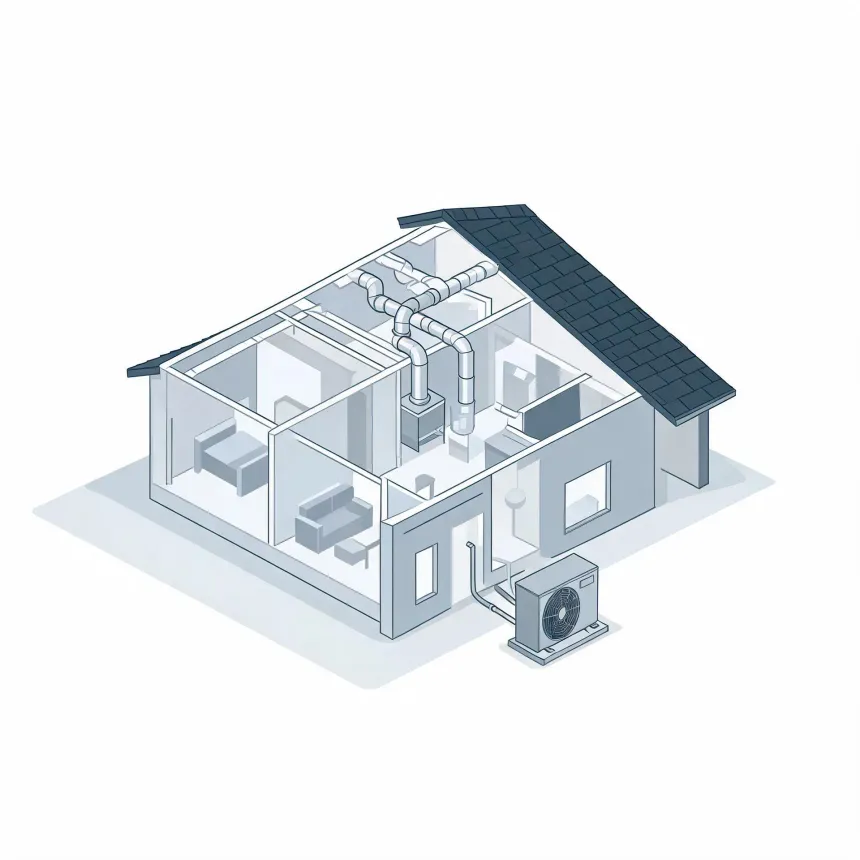
Isometric line illustration of a cutaway house showing interior rooms with furniture, ceiling ductwork connected to an indoor air handler, and an outdoor condenser unit linked by refrigerant lines.
Your system heats October through May and cools June through August.

NOAA nClimDiv, 1991–2020 normals

Springfield winters average 23°F overnight. Cold enough to make the heat pump work, but not brutal on it.

A heat pump here does more heating than cooling. That's steady work, not hard work. So most of the time, a repair is the right call, not a reason to replace it.

Worth a repair call before you consider anything bigger

Get a repair quote before even thinking about replacement. A heat pump that's spent most of its life on steady heating, not hard cooling, usually has a simple fix behind the problem. Worth knowing before any bigger decision gets made.

Find a contractor
A man in a cap, dark jacket and tan work pants carries a canvas tool bag up white porch steps toward a dark blue paneled front door, with a potted shrub beside the entry.
A dark gray heat pump unit mounted on a concrete pad next to a house with gray siding and a stone veneer wall.

What a struggling heat pump sounds and feels like before it quits

Short cycling is the one most people notice first. The unit kicks on, runs a few minutes, shuts off before the room feels any different. That happens over and over through the day. That usually means the system can't finish a full heating cycle. Often the refrigerant charge has dropped enough that the compressor trips on protection. Sometimes a sensor is telling it to stop early. Air coming out of the vents barely warm, or outright cold, when the thermostat says it's heating, points to a reversing valve stuck in the wrong spot, or a refrigerant problem. That won't sort itself out by waiting. Listen for a hard clunk or buzz when the system should be switching between heating and defrost. That's the reversing valve. When it won't shift cleanly, the unit can get stuck heating the outdoor air instead of the house. A breaker that trips every time the heat pump kicks on means the compressor is pulling more current than it should. Shut the system off until someone looks at that one.

Check the thermostat and the breaker first

Make sure the thermostat is set to heat, and the set temperature is actually above room temperature. A setting bumped by accident looks just like a broken unit. Check the breaker for the heat pump, and the one for the air handler or furnace. Either one tripping will stop the house from heating.

Look at the outdoor unit before you call

Walk outside and check the outdoor unit. See if it's buried in leaves, iced over beyond a thin normal frost, or blocked by something stacked against it. That unit pulls heat from the outside air, and it needs airflow in and out to do it. A unit that can't breathe will struggle no matter what else is wrong.

A compressor that trips its breaker and gets switched back on and left running is the one that turns a repair into a replacement. It trips because it's drawing too much current. That's usually a low refrigerant charge or a failing start component. Every restart after that puts more load on windings that are already stressed. Short cycling wears on the compressor the same way. A unit that keeps shutting off before it finishes a cycle is starting up over and over, and starting is the hardest moment in any cycle. Ice on the outdoor coil follows the same pattern. A thin coat that clears during defrost is normal. A coil that's iced over and kept running will only add more ice, because it can't pull heat through ice the way it pulls heat through bare metal. Any one of these signs means shut it off and get someone to look at it. Don't wait to see if it clears on its own.

Age and the compressor are what decide this, not whatever symptom sent you looking. A reversing valve, a capacitor, a sensor, a tech swaps those out and the unit runs like it did before. The compressor's different. It's sealed up, it's the priciest part in the system, and when it's failing for real, not just tripping a safety switch, there's no part to swap in. A heat pump still running on its original compressor, kept clear of ice and debris, is usually worth fixing no matter what else breaks on it. One that's already had a compressor replaced, or is showing compressor failure now, that's telling you the next fix won't be the last one.