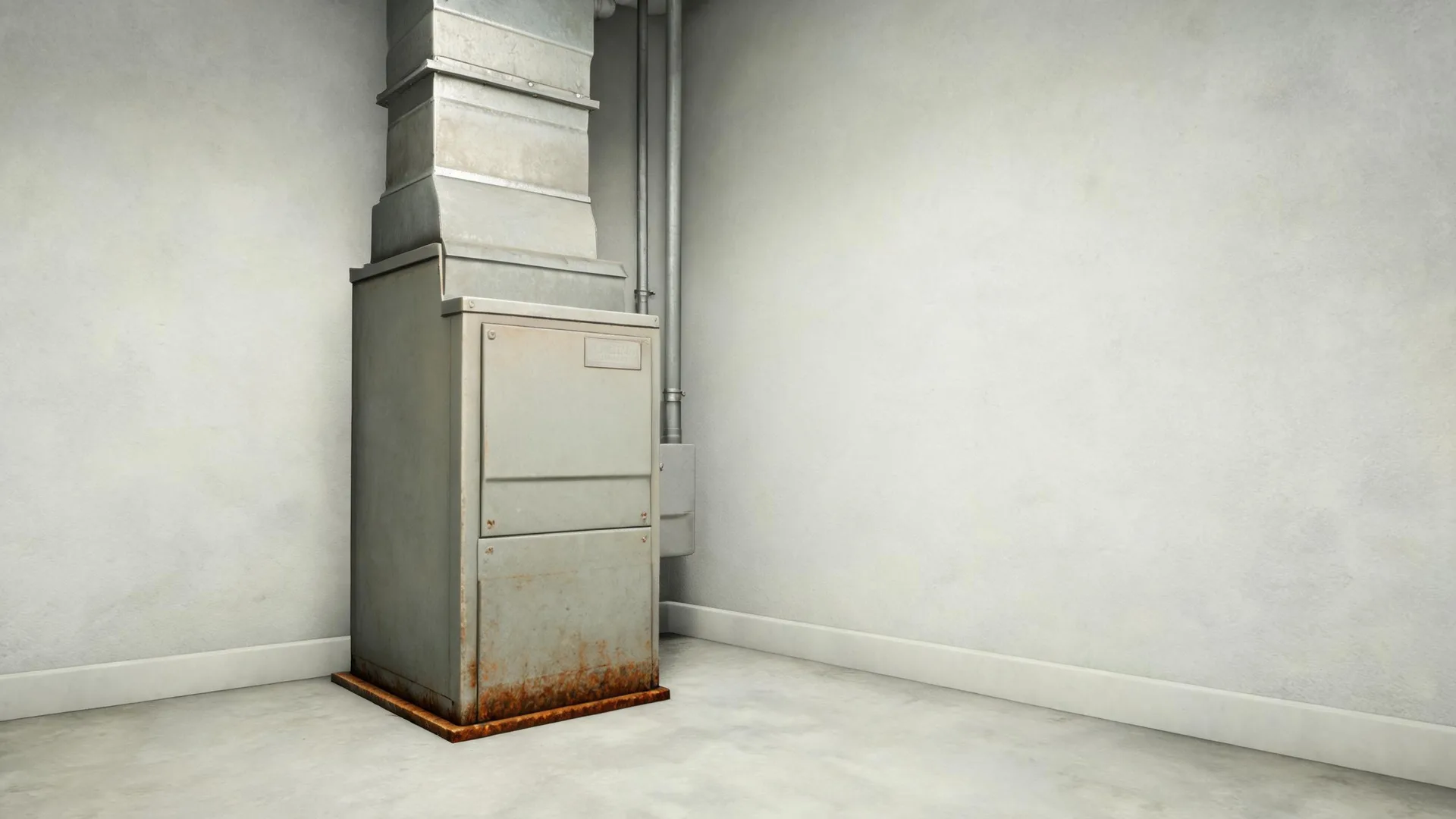
Eight months of real work
A Mentor furnace runs from October through May, not just on the coldest days. That long a season puts normal wear on the same parts, year after year. That's usually why one of them finally gives out.
Takes about a minute. No obligation.
A Mentor furnace runs from October through May, not just on the coldest days. That long a season puts normal wear on the same parts, year after year. That's usually why one of them finally gives out.
Overnight lows around 23°F aren't extreme for this area. The furnace isn't being asked to do anything out of the ordinary. A breakdown almost always comes down to a part that wears out on any furnace, not something particular to this house.

NOAA nClimDiv, 1991–2020 normals
A furnace that won't start isn't always broken. Sometimes it's just a switch that got bumped off.
Check the switch on the furnace itself. Check the breaker too. And swap the thermostat batteries. Do that before anything else.



Natural gas in Ohio ran $12.89 per million Btu last year. A furnace that's short-cycling or running longer than it should is burning real money while it struggles. So find the actual cause instead of resetting the system and hoping it holds. A failing igniter or a dirty flame sensor doesn't get better on its own. Running the furnace hard against a bad part just wears the next part down faster. Most failures come down to a handful of parts doing the same job every winter until one quits. Knowing which one it is matters more than guessing.
Nothing about this area is especially hard on it. It's most likely the usual problem with the usual fix.
Find a contractor
The tech asks what the furnace was doing right before it quit. Then watches it try to run. That usually points to the ignition system, the flame sensor, or the blower, since each one fails its own way. After that it's a multimeter and a handful of checks. Voltage at the igniter. Continuity on the limit switch. Resistance across the motor windings. None of this takes long once the furnace is open. The list of parts that actually fail is short, and a tech has seen each one go bad before.
The igniter heats up and cools down every time the furnace kicks on. That cycle is what cracks it eventually. Once it's failing, it usually won't glow at all. Or it glows weak and dim instead of bright white.
A flame sensor picks up a film of carbon every season. Once that coating gets thick enough, it can't read the flame anymore. The furnace thinks there's no flame and shuts down, even though the gas is burning fine right in front of it.
Estimates for a typical Lake County home, compared with an older unit built to the previous federal minimum, from EIA household energy data, Ohio fuel prices and NOAA climate normals. Your home will differ.
Repair makes sense when one part has failed and the heat exchanger is sound.
Replacement makes sense when the heat exchanger is cracked or the furnace keeps needing parts.
A furnace is worth fixing almost every time one part has failed. An igniter, a flame sensor, a blower motor, these are known, bounded repairs, and the rest of the furnace keeps running the same as before. What changes the math is when the heat exchanger cracks, or when the furnace is old enough that one repair this year just means a different part next year. A tech checks the age and condition of the cabinet and the exchanger while they're already in there looking at the failed part, since that's the only way to know which kind of problem this is. If the exchanger is sound, fixing what broke is the straightforward answer. If it's not, no repair fixes that.