A nighttime street view of several illuminated two-story red brick homes with front porches, flanked by a large tree.

Furnace Repair in Hamilton, OH

Tell us about the job

Takes about a minute. No obligation.

RepairFurnace or heatingButler County, OH
Step 1 of 2

What ZIP code is the job in?

September is when to get a furnace looked at

Furnaces in Butler County sit idle most of the year. They start back up in October. A weak igniter or a failing inducer motor can look fine on a quick glance in summer and still quit on the first cold week it has to work.


A breakdown in October often traces back to spring

If the furnace is acting up right as the season starts, the cause is usually a part that was already wearing out. The cold didn't cause it. Find that part and fix it, and the next seven months go a lot smoother.

7 months
October through April, your furnace is on duty
24°F
the average winter night it heats against
52%
of homes here heat with gas, so most furnaces here burn gas
13 winter storms
in ten years, the nights a failure hurts most
Isometric cutaway illustration of a house with a shingled gable roof, showing a gray furnace unit connected to overhead ductwork and a chimney flue, with simplified furniture in the rooms below.
Your furnace works hardest from November through March.

NOAA nClimDiv, 1991–2020 normals

Furnace season in Butler County runs October through April, about seven months.

Most breakdowns happen because the furnace sits idle the rest of the year, not because of anything unusual about the cold.

Half the homes in Butler County were built in 1979 or later

Half the homes here were built by 1979
Heat runs October through April
Winter nights average 24°F
Your furnace's problem isn't the weatherButler County had 160 severe weather events between 2015 and 2024. None of that points to a furnace problem. That's just the county's weather record.

A furnace built alongside a newer house still has most of its working life ahead of it. That's reason enough to ask for a repair first and a replacement only if the technician tells you the unit itself is failing, not just one part. Find out what broke before you decide what to do about the whole system. Most of the time, the part that failed is the only thing that needs attention.

Get it looked at early

Problems tend to show up in the first weeks of the season, when the load hits a part that was already weak.

Find a contractor
A man in a cap, dark shirt and tan work pants walks up porch steps toward a navy blue front door, carrying a canvas tool bag beside a potted shrub.
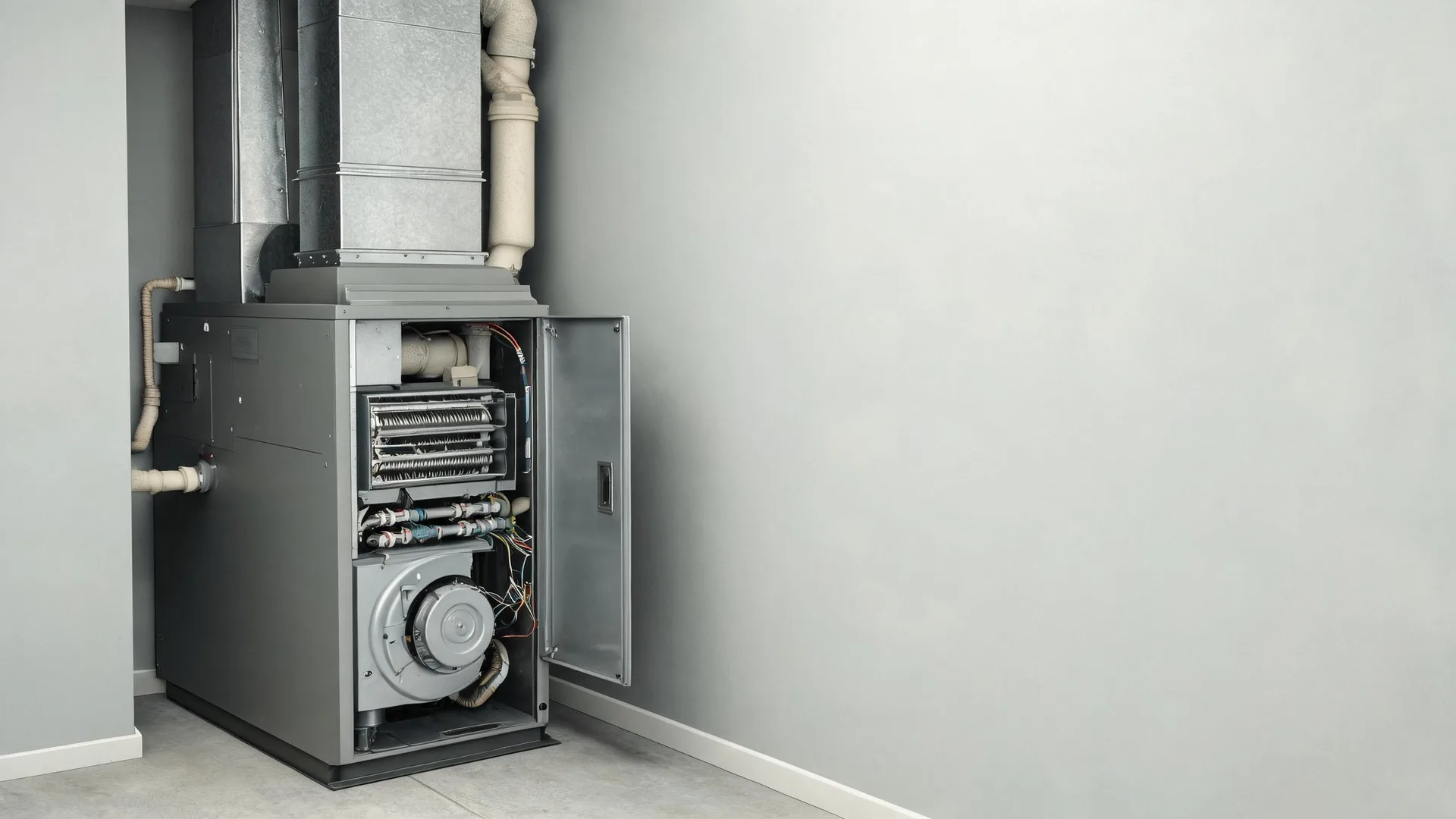
A gray residential gas furnace installed in an unfinished basement, surrounded by ductwork, a metal flue pipe, and a gas supply line.

The parts that fail are the parts that cycle

Most furnace failures trace back to parts that cycle on and off, not parts that run steady. The igniter heats up and cools down every single cycle, and that repeated flexing is what eventually cracks it. The flame sensor sits right in the burner flame every time the furnace fires, and over enough cycles it builds up a coating that keeps it from sensing the flame at all. The inducer motor starts and stops with every call for heat too, and the bearings inside wear from that stopping and starting more than from the hours they spend actually turning. None of this shows up while the furnace sits idle. It shows up at the start of the first cold cycle, when a part that was close to failing gets asked to work again.

What you'll notice first

A furnace that short cycles, running briefly then shutting off before the house warms up, usually means the flame sensor can't detect the flame anymore. One that clicks and tries to start but won't catch is more likely the igniter. Cold air blowing before any warm air shows up often means the burners are firing late, or missing the first try completely.

What it means for the call

Tell the technician exactly what's happening, not just that the furnace isn't working. A rattle at startup. A burning smell that fades. A thermostat calling for heat with no response. Details like that point toward a specific part before the cabinet even comes off. That keeps the visit focused on the actual problem instead of a search for it.

An unfinished basement featuring a grey forced-air furnace with metal ductwork, concrete block walls, exposed wooden joists, and a single hanging bare bulb.

A new furnace would cut about $150 a year off heating for a typical Butler County home.

  • A new high-efficiency furnace$590 a year
  • An older furnace$740 a year

Estimates for a typical Butler County home, compared with an older unit built to the previous federal minimum, from EIA household energy data, Ohio fuel prices and NOAA climate normals. Your home will differ.

Repair makes sense when one part has failed and the heat exchanger is sound.

Replacement makes sense when the heat exchanger is cracked or the furnace keeps needing parts.

Age is the main question. Usually the furnace answers it plainly. If the heat exchanger is cracked or the burners are rusted through, no single part fix gets around that, and a tech will say so straight out. But most calls aren't that. A bad igniter or a dirty flame sensor doesn't mean the furnace is done. It means one part wore out after years of cycling on and off. Ask what actually broke before asking what a whole new furnace costs. If the rest of the unit is sound, fixing that one part gets through this winter and several more, without touching anything that's still working fine.