A row of dark-painted single-story houses with gabled shingle roofs behind a trimmed hedge and mown lawn, surrounded by large leafy trees under an overcast sky.

Furnace Repair in Columbus, OH

Tell us about the job

Takes about a minute. No obligation.

RepairFurnace or heatingFranklin County, OH
Step 1 of 2

What ZIP code is the job in?

Franklin County sees its share of storms

Franklin County logged 268 severe weather events between 2015 and 2024, including 174 damaging wind events, 79 hail events, and 8 tornadoes. Winter storms hit 6 times in that span. Statewide, 18% of Ohio households lost power for 24 hours or more in 2024.

Furnaces depend on power and a clear outdoor unit

A furnace needs electricity to run the blower and igniter, even in a gas system. Hail and wind-blown debris can hit the outdoor condenser unit that works alongside it for cooling. A long outage or a storm that's come through is reason enough to have the system looked at, whether or not it's acting up yet.

8 months
October through May, your furnace is on duty
24°F
the average winter night it heats against
67%
of homes here heat with gas, so most furnaces here burn gas
6 winter storms
in ten years, the nights a failure hurts most
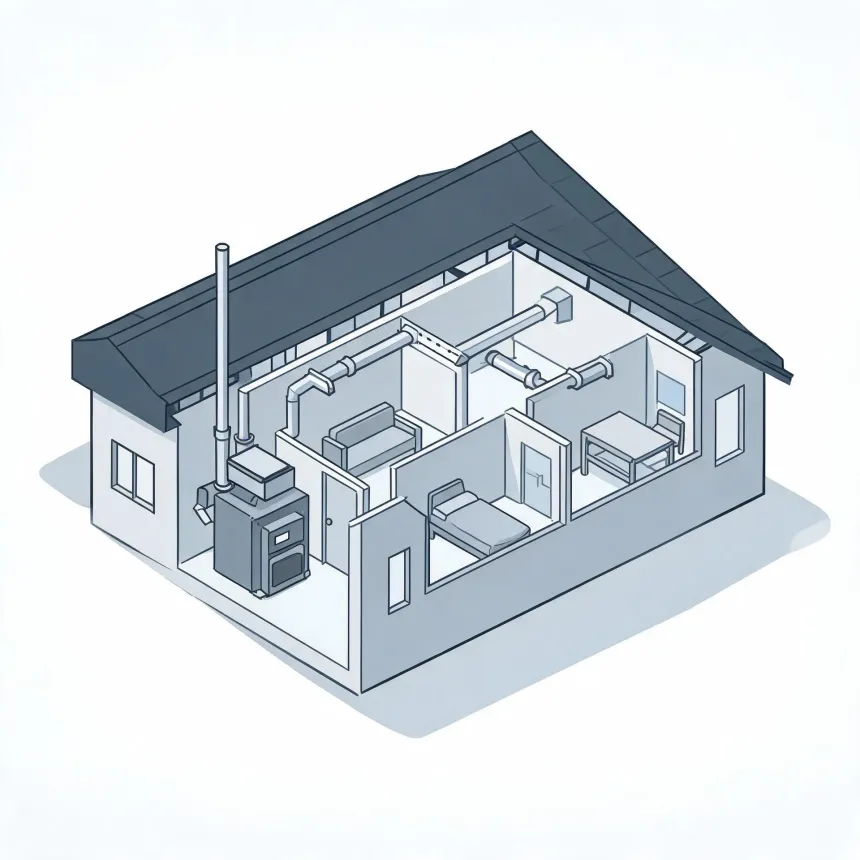
Isometric cutaway illustration of a single-story house showing interior rooms with furniture, overhead ducting, a flue pipe, and a furnace unit against an interior wall.
Your furnace works hardest from November through March.

NOAA nClimDiv, 1991–2020 normals

A furnace that short cycles is stressing a part, not just annoying you.

Short cycling wears out the one part causing it, and that part only gets worse left alone.

Half the furnaces here haven't hit the halfway point of their life

Half the homes here were built by 1979
Climate zone 4A
Heat runs October through May
October is when weak furnaces failHeat starts running in October here, and that first real cold is what finds the part that was already wearing out.

If your furnace came with the house and the house went up in 1979 or later, it's probably not that old. A furnace that age is usually worth fixing rather than replacing. The parts that fail first, the igniter, the flame sensor, the blower motor, can be swapped without touching the rest of the system. Worn parts like these are also what a storm or a long outage tends to expose first, which is why it's worth having it looked at now rather than waiting for the next cold snap to find out.

If a storm's come through, get the furnace checked before the cold proves it

A furnace that's been running fine can still be carrying damage from wind or hail nobody's looked at yet. If the outdoor unit took a hit, or the power's been out for a day or more, that's reason enough to have someone check the system now, before the next cold snap finds the part that storm already weakened.

Find a contractor
A gray high-efficiency gas furnace installed in an unfinished basement, surrounded by gas lines, a condensate drain, and sheet-metal ductwork.

Most furnace failures are one small part, not the whole system

A furnace fails the same handful of ways over and over. The igniter cracks or weakens with age and stops lighting the burners. The flame sensor coats with a thin layer of residue until it can't tell the burner is lit, so the system shuts itself down as a safety measure. The blower motor wears out after running for years, and bearings go bad before the motor quits outright, which is usually what you hear first. Flame sensors and igniters take the most heat and the most cycles, so they tend to go before the bigger parts like the blower or the heat exchanger. A system that's run for a long time without anyone looking at the burners or checking the flame sensor is a system that's closer to one of these failures than it looks from the outside.

A cracked heat exchanger can start small

A hairline crack in the heat exchanger doesn't stop the furnace from running. It keeps heating the house while exhaust gases work their way into the airflow instead of staying contained and vented outside. Each cycle flexes the metal a little more, and the crack opens further. Left running, a problem that started as a small defect becomes a reason the whole exchanger needs replacing instead of being caught early.

A failing part drags down the one next to it

A blower motor running on worn bearings pulls more current to do the same job. A flame sensor coated in residue makes the system fire and shut down over and over as it struggles to sense the flame. Every extra cycle like that puts strain on the igniter, the control board, and the motor itself, so the parts around the original problem start wearing faster too. Shutting the system down and having it looked at stops that chain before it spreads.

An unfinished basement interior featuring a large metal furnace unit, exposed ceiling joists, concrete walls, and scattered boxes and cables on the floor.

A new furnace would cut about $150 a year off heating for a typical Franklin County home.

  • A new high-efficiency furnace$620 a year
  • An older furnace$770 a year

Estimates for a typical Franklin County home, compared with an older unit built to the previous federal minimum, from EIA household energy data, Ohio fuel prices and NOAA climate normals. Your home will differ.

Repair makes sense when one part has failed and the heat exchanger is sound.

Replacement makes sense when the heat exchanger is cracked or the furnace keeps needing parts.

Age isn't really the question that decides repair versus replacement. Condition is. A furnace with a cracked heat exchanger needs a new heat exchanger or a new furnace, because that part isn't something anyone patches. A furnace with a bad igniter or a failed flame sensor just needs that part swapped, and it runs another several years on the rest of the system. The right question to ask is how much of the furnace the failure actually touches. A control board or a blower motor can usually be replaced on its own without the repair cost creeping toward what a new system would run. It's when two or three parts are failing at once, or the one that's failing is the heat exchanger itself, that fixing it stops making sense next to starting over.