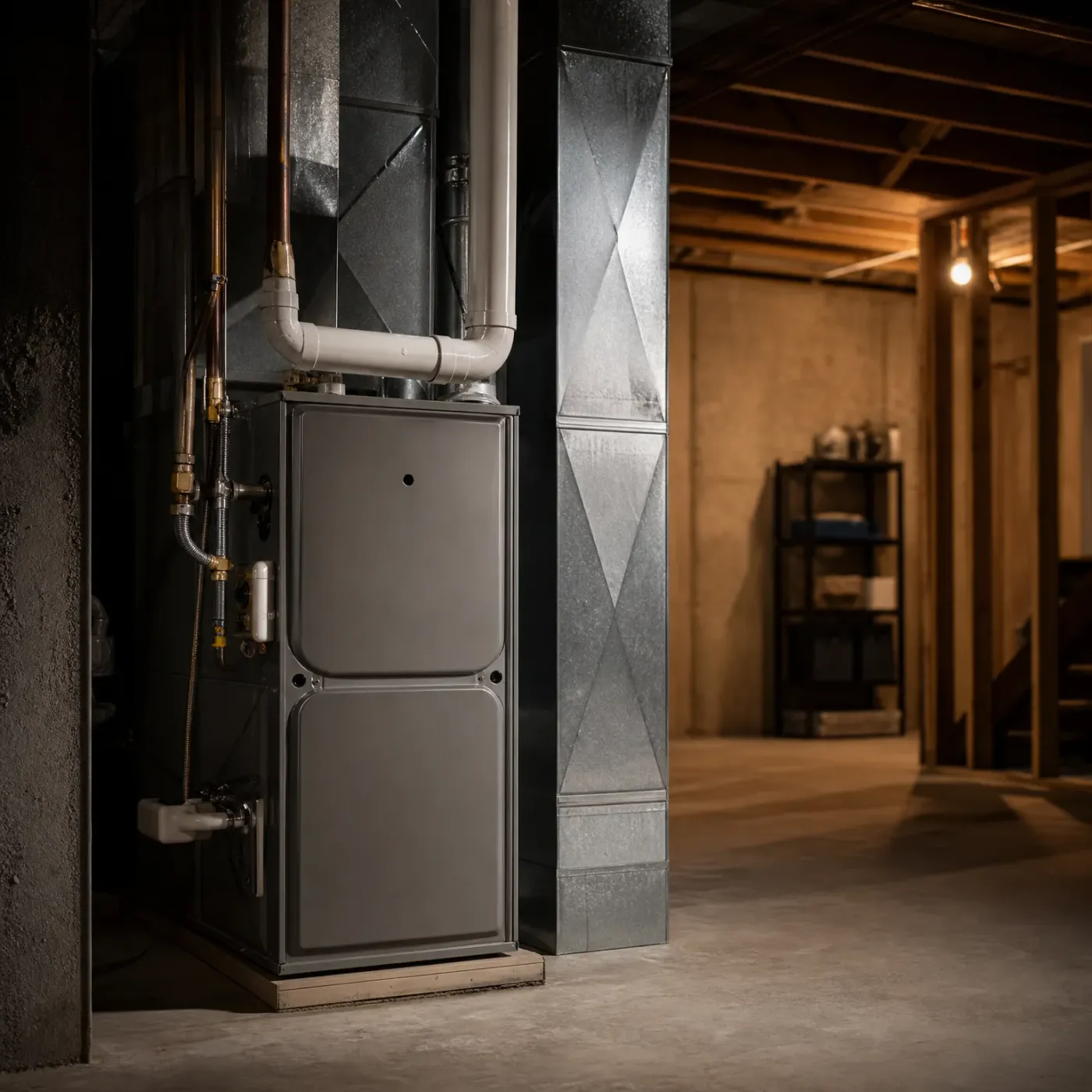









A gray gas furnace with copper and PVC piping stands beside large galvanized sheet-metal ductwork in an unfinished basement with concrete floor, wood framing, and a glowing bare bulb in the background.

Get your furnace to the right pro

What size furnace an Ohio home needs

Furnace size comes down to your square footage, your insulation, your ceiling height, and how cold it gets where you live in Ohio. Too small and it runs nonstop in January. Too big and it short cycles, wearing out parts early. Below is what goes into sizing one right, and a way to get a contractor who can size yours and take it from there.

Get matched

There's no single size that fits every Ohio house. A tight, well insulated 1,800 square foot home might need a furnace rated around 45,000 BTUs, while a drafty older home the same size could need 70,000 or more. The reason comes down to heat loss: a furnace has to replace the heat your walls, windows, and ceilings let escape, and Ohio winters push outdoor temperatures low enough that undersized units can't keep up. A contractor sizes a furnace with a load calculation, not a chart based on square footage alone, because two homes the same size can lose heat at very different rates. Getting the number right matters more here than in milder states. A furnace that's too small will run constantly on the coldest nights and still leave rooms cold. One that's too big will heat the house fast, shut off, then kick back on again and again, which wears out its parts sooner than it should.

A gray high-efficiency furnace with two PVC vent pipes stands in an unfinished basement beside sheet-metal ductwork, a framed and plastic-covered wall, and a bare concrete wall with vertical pipes.
A furnace sized to the house runs long, steady cycles that keep rooms even without strain on the ductwork above it.
A gray furnace cabinet in a basement, connected to galvanized sheet-metal ductwork and white PVC pipes, against a concrete wall with exposed metal piping and insulation overhead.
A furnace sized wrong sits oversized on its pallet, short cycling through the ductwork and wearing itself out early.

How Contractors Calculate the Right Size

  • A Manual J load calculation is the industry method, weighing square footage, insulation, windows, and air leaks together.
  • Contractors measure in BTUs per hour, the heat a furnace must produce to replace what the house loses on a cold night.
  • Your local design temperature, the coldest outdoor reading the furnace is expected to handle, sets the baseline for the calculation.
  • Ceiling height matters because a room with 9 foot ceilings holds more air to heat than one with 8 foot ceilings.
  • Window count and orientation change the number since glass loses heat faster than an insulated wall.
  • Ductwork size has to match the furnace output, or the air can't move fast enough to heat the rooms evenly.

Sizing a furnace isn't a guess based on square footage alone. A contractor doing it right runs a Manual J load calculation, the method the industry has used for decades to add up everything that makes a house gain or lose heat. Square footage is one input. Insulation levels, window count, window orientation, air leaks, and ceiling height all get weighed together, because each one changes how fast the house loses warmth on a cold night.

The output of that calculation is a number in BTUs per hour, which is the rate of heat the furnace has to produce to replace what's escaping. That number depends heavily on your local design temperature, the coldest outdoor reading your furnace is expected to keep up with on an average winter night. A house in a colder part of Ohio needs a furnace sized for a lower design temperature than one in a milder spot, even if the two houses are identical otherwise.

Ceiling height is easy to overlook but it matters. A room with 9 foot ceilings holds more air than the same room with 8 foot ceilings, so it takes more BTUs to bring it up to temperature. Windows work against the furnace too, since glass loses heat much faster than an insulated wall, and a house with more south or west facing glass carries a different load than one with fewer windows.

Once the BTU number is set, the ductwork has to be able to deliver it. A furnace rated correctly on paper still won't heat the house evenly if the ducts feeding it are too small to move that much air.

An older man with gray hair, a dark coat and scarf dusted with snow stands in a warmly lit entryway with an open wooden door, a table lamp, framed pictures, and a plant in a vase.
An older man with gray hair and a beard wearing a dark snow-dusted coat stands in a home entryway, with a lamp-lit living room and a wooden staircase behind him.
An older man with gray hair and a beard, wearing a dark snow-dusted coat, stands in a warmly lit home entryway with a hallway, console table with lamp, patterned rug, and living room visible behind him.
A gray-haired bearded man in a dark snow-dusted coat and scarf stands inside a dimly lit home entryway, with a hallway, framed picture, lit table lamp and staircase behind him.

The right pro for this job

One request ends the search for a furnace installer.

You're not committing to anything by asking.

Why a cold snap exposes the wrong size

An undersized furnace can keep a house comfortable on a mild day and still fail you in January. Ohio winters bring stretches of single digit nights, and that's when heat loss is at its worst. A furnace rated too low for the house runs constantly trying to keep up, and on the coldest nights it still won't reach the thermostat setting. An oversized unit has the opposite problem. It blasts the house to temperature fast, shuts off, then fires again twenty minutes later. That short cycling puts more wear on the ignition system and the blower motor than a properly sized furnace sees in years of normal runs.

What the nameplate and ductwork tell a contractor

The BTU rating on a furnace's nameplate only means something next to the house it's heating. A contractor checks that number against the Manual J results, then looks at whether the existing ductwork can actually deliver that much air. A furnace sized up without matching the ducts can leave rooms far from the unit cold no matter how hard it runs. This is why two houses with identical square footage can end up with different furnace sizes and different duct modifications. Power costs more here than in a lot of states, so a furnace that's sized and ducted correctly keeps the gas burning efficiently instead of paying for air that never reaches the rooms that need it.

A gray metal furnace with two white PVC vent pipes stands on a concrete floor beside galvanized sheet-metal ductwork in a basement or utility space with wood framing.
Before you get your furnace installation
A gray furnace cabinet in a basement with sheet-metal ductwork, white PVC vent pipes, and black gas piping against a concrete wall and wood-framed partition on a bare concrete floor.
After you get your furnace installation

Run the wrong size furnace through an Ohio winter and you'll feel it in specific rooms first, the ones farthest from the unit, while your gas bill climbs faster than the temperature outside drops.

An installer who sizes it to your house instead of guessing from the old unit's label fixes both at once: even heat room to room, and a bill that tracks the weather instead of outrunning it.

Winter nights average 23°F statewide

23°F is the average overnight low across an Ohio winter, but your furnace has to handle the nights well below that too. That's the load a correctly sized unit is built to cover, not just the average.

NOAA nClimDiv 1991-2020 county normals weighted by homes

A beige high-efficiency furnace stands on a concrete basement floor beside sheet-metal ductwork, with white PVC vent pipes and a gas line running along an insulated wood-framed wall.

Right size, running clean

A correctly sized furnace like this one ties into the ductwork without strain. The flue pipes, gas line, and drain all do their job without the unit fighting to keep up. It cycles on, heats the house, and shuts off, no drama.


An older metal furnace with a louvered front panel stands against a concrete basement wall, connected to sheet-metal ductwork and a flue pipe, with copper and steel pipes running alongside.

Wrong size, showing it

A furnace pushed past what it was built for wears faster than it should. Dust collects, cycles get short, and the cabinet shows age sooner than it would otherwise. By the time it looks like this, it's often been working harder than it needed to for years.

Why does one room never get warm enough

If a furnace is undersized, you notice it in the room farthest from the unit first, usually a bedroom over the garage or a room with a lot of windows. It never quite hits the thermostat setting on a cold night. You might also notice the furnace running almost constantly from December through February instead of cycling on and off, and a gas bill that keeps climbing even though you haven't changed the thermostat. If it's oversized instead, you'll hear it kick on and off every few minutes, even in milder weather, and some rooms may feel warm in blasts rather than staying even. Left alone, either problem puts more wear on the blower and the heat exchanger than a correctly sized furnace would see.

A woman wrapped in a thick wool blanket sits in an armchair with an open book on her lap, beside a lit lamp and a frost-patterned window.
A smiling older woman with gray hair in a loose bun wearing a ribbed beige sweater stands in a dimly lit kitchen beside a window showing darkness outside, with a loaf of crusty bread on a wooden board in the foreground.
A man in a dark polo shirt and cap, seen from behind, walks up a paver path toward a woman standing in the open front doorway of a single-story stucco and stone house.

The right size is the one your house actually loses

A Manual J calculation settles it. Not the square footage alone, not what the last furnace happened to be, but what your house actually loses on a cold night. That number is the furnace you need, and it's different for the house next door even if it looks the same from the street.

Getting there isn't a guess you make from a chart. A contractor who sizes a furnace for your house, your insulation, your windows, is doing work specific to you, not pulling a number off a shelf. Once you're matched with one, that work is theirs to do, and the sizing question stops being something you have to figure out on your own.

Interior corner of a living room with a sheer-curtained window, a light wood console table holding a vase of greenery and a shallow bowl, a woven basket on the lower shelf, and a blurred upholstered sofa and dark wood table in the foreground.
An empty basement with bare concrete walls and floor, exposed wooden joists and pipes overhead, and a dark furnace with sheet-metal ductwork and vent pipes in the right corner.

Matched to your furnace job

Send the form and the search for an installer is over.

New system or replacementFurnace or heatingOhio
Step 1 of 2

What ZIP code is the job in?