

Is a high-efficiency furnace worth it in Zanesville, OH

Get matched

Your gas furnace runs for months here, and Muskingum County's power rates are high, so the question of a high-efficiency model isn't a small one. A 95% or 96% AFUE furnace costs more going in than a standard 80% unit, and whether that gap makes sense for your house depends on things specific to your setup, like venting, your current ductwork, and how your home holds heat. That's not something a generic answer can settle. Getting a straight read on it usually means calling a few contractors, explaining your house and your furnace situation each time, then trying to compare quotes that are never quite apples to apples. This page skips that. Answer a few questions about your home and you'll be matched with a contractor who installs furnaces in this area and knows what the efficiency question actually comes down to for a place like yours. They'll reach out directly, so you're not the one chasing callbacks or explaining your situation from scratch over and over.

Is a high-efficiency furnace worth it in Zanesville, OH?

You're trying to figure out if spending more upfront on a 95% or 96% AFUE furnace actually pays off where you live, or if an 80% unit does the job for less money. With a long heating season and high power rates in Muskingum County, the gap between the two matters more here than it would somewhere milder.

For most homes in Zanesville, yes, if you plan to stay put for a while

A high-efficiency furnace burns less gas to make the same heat, and in a county where the furnace runs from October into April, that difference shows up on every bill for five or six months straight. The higher upfront cost is real, and so is the payback, but the payback is slower if you only run the furnace a few months a year. Here, you don't. The other thing worth knowing: a 95% or 96% AFUE furnace vents through PVC pipe out a sidewall instead of up a chimney, which matters if your current furnace shares a flue with a water heater. That's a question for whoever installs it, not something to guess at.

  1. A second heat exchanger pulls more heat from the exhaust.

  2. Flue gas cools enough to condense into water.

  3. A condensate drain carries that water out of the furnace.

  4. PVC venting replaces metal flue pipe because exhaust runs cool.

How cold and how long does your furnace actually have to work here?

  • Winter nights average 23°F

    Winter nights here average 23°F, so your furnace is firing at full output on the coldest nights, not easing through mild ones.

  • Heat runs October through May

    Heat runs October through May in Muskingum County. That's eight months a year your furnace is the one covering the gap in efficiency.

  • 55.2% of homes heat with gas

    55.2% of homes in the county heat with gas, same as yours. That's the fuel the AFUE rating on a new furnace actually applies to.

NOAA nClimDiv 1991-2020 · ACS 2020-2024

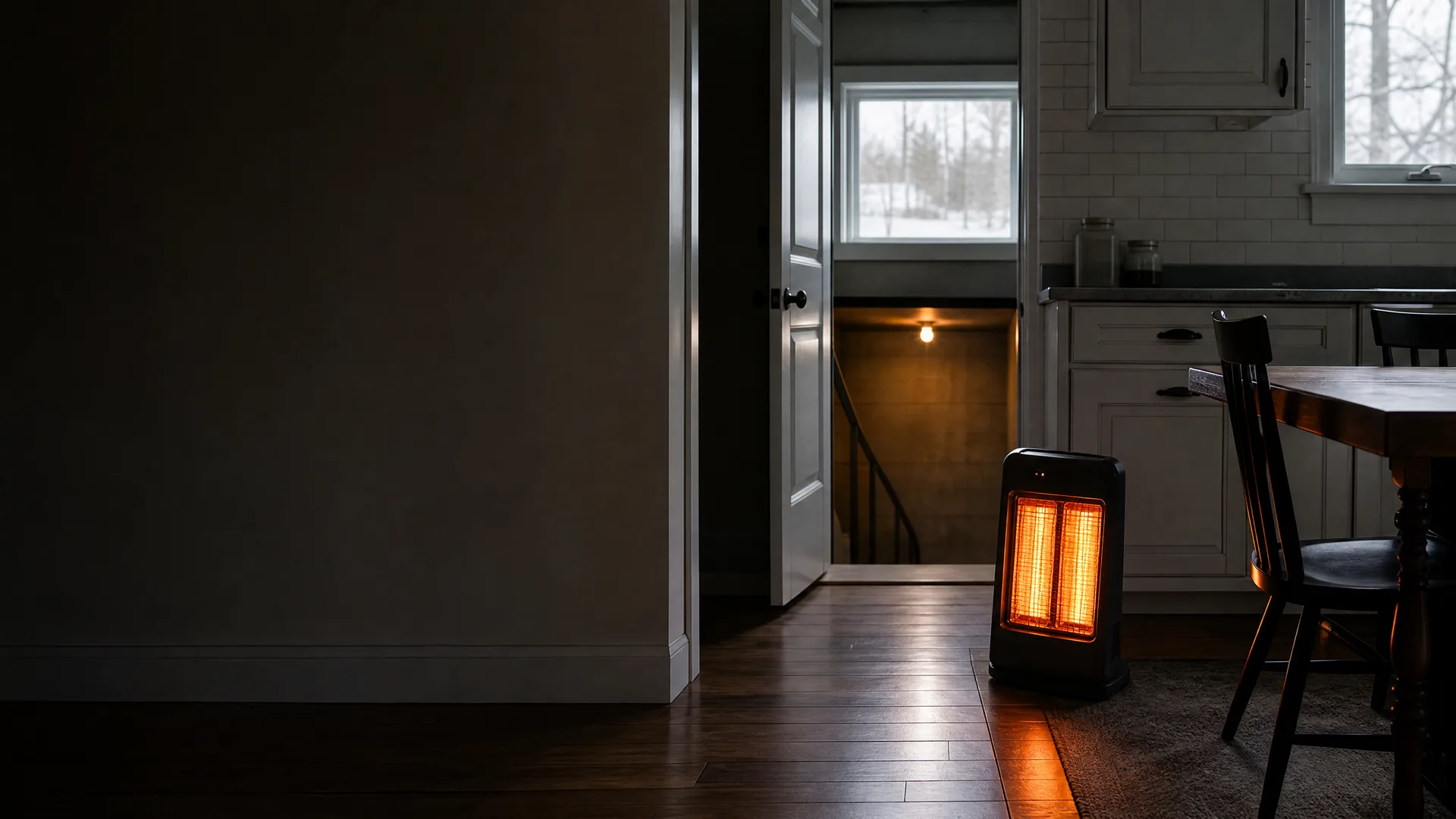
A portable electric space heater with glowing orange elements stands on a dark wood floor in a dim room beside an open door leading to a lit stairway, with a kitchen counter, window and wooden table and chairs at right.

The space heater by the kitchen table is doing the work this morning, and the furnace in the basement isn't. It's a little past six, still dark outside, the kind of late-February cold that sits on a Muskingum County house overnight. The basement door is open behind you. You've been down there twice, listening for the burner to catch, and twice it hasn't. So the space heater runs, orange coil glowing, while you wait for a decent hour to call someone. A furnace that keeps short-cycling or won't fire at all on the coldest mornings doesn't wait for a convenient time, and once you're ready to deal with it, the next step is getting a contractor who installs furnaces out to look at what you have and what would actually fit your house.

A furnace pro near you

You've seen what the winters here demand of a furnace and what the power bills already look like. That's the math you're actually weighing, not a general question about efficiency ratings. An 80% unit will heat your house. A 95% or 96% unit will do it burning less gas every one of those months from October to May, and in a county with expensive power, the gas side of that equation carries more weight than it would somewhere milder. Whether the higher-efficiency furnace is the right call for your house depends on things a page can't know from here: your current unit, your ductwork, what the install itself involves. A contractor who's looked at your furnace and your basement can tell you where that line actually falls for you, instead of you trying to work it out from averages. That's the conversation worth having before the next cold snap finds the gap in whatever's down there now.

An 80% AFUE furnace sends about one of every five dollars of gas out the flue. It costs less to install and it will keep a Muskingum County house warm through a cold winter, same as it always has.

A 95% or 96% AFUE furnace keeps almost all of that gas as heat instead of exhaust. Over a seven-month heating season here, that difference runs on every single cycle, not just the coldest nights.

A woman wrapped in a thick fleece blanket sits on a sofa holding an open book, beside a lit table lamp and a frost-covered dark window.
A bearded man in a plaid flannel shirt stands indoors beside a wood-framed, frost-covered window, looking outside, with a steaming brown mug on the sill and a wooden cabinet behind him.

What the venting tells you

An 80% furnace vents through metal flue pipe because the exhaust is still hot enough to need it. A 95% or 96% furnace vents through PVC pipe, often straight out a side wall, because the second heat exchanger has already pulled most of the heat out of that exhaust. If you're standing outside a house and see PVC pipe coming out near the ground instead of a metal flue going up through the roof, that's a high-efficiency furnace. The same difference shows up in the condensate drain. An 80% unit doesn't have one. A high-efficiency unit does, because the cooled exhaust condenses into water that has to go somewhere.


Where the gas actually goes

An 80% AFUE furnace burns one dollar of gas and sends about twenty cents of it straight out the flue as heat that never reaches the house. A 95% unit keeps ninety-five cents working. Over a Muskingum County winter that runs October through May, that gap applies to every therm burned the whole time, not just the coldest nights. It's the second heat exchanger that makes the difference, pulling heat out of the exhaust before it leaves the house instead of letting it go up the flue while it's still hot.

Winter nights average 23°F

At 23°F, your furnace isn't cycling on and off for a few hours of chill. It's running long stretches to hold the house steady through the night, every night, all winter. That's the load a high-efficiency unit has to earn back.

NOAA nClimDiv 1991-2020

A house that holds its heat well

If your walls and attic are insulated well and the windows don't leak air, the furnace doesn't run as long to hold a temperature. Less runtime means less gas burned, and less gas burned means the higher AFUE has less to work with. The 10 to 15 percent difference between an 80% and a 95% unit still applies, but it applies to a smaller number. A well-sealed house in Muskingum County can still see a long payback on the upgrade, even with winters this cold, because the furnace simply isn't firing as many hours as it would in a drafty one. Check your last few gas bills against a neighbor's similar-sized house if you can. If yours runs noticeably lower already, that's a house where the standard unit has less room to lose.

A house that loses heat fast

An older house with single-pane windows, a leaky attic hatch, or walls without much insulation asks the furnace to run longer and more often to hold the same temperature. More runtime means more gas burned over the winter, and that's exactly where the gap between 80% and 95% AFUE shows up in the bill. A furnace that's cycling for most of the night, every night from October through May, burns through enough gas that the fuel saved by the higher-efficiency model adds up faster than it would in a tighter house. If you've patched drafts or added insulation and the bills haven't moved much, the house itself may be where the money is going, and that's worth knowing before you decide between the two furnaces.

A beige furnace with a louvered front panel and metal ductwork stands on a concrete basement floor beside pipes and a white cylindrical water heater.
Before you get your furnace installation
A gray high-efficiency furnace in a basement with PVC venting pipes, a yellow gas line, metal ductwork, concrete walls and floor, and a wood-framed stairway at left.
After you get your furnace installation

A long winter and a high power rate are the two facts that decide this, and Muskingum County has both. An 80% furnace will keep a Zanesville house warm through every cold night from October to May, same as it has for years. A 95% or 96% furnace burns less gas doing it, and over a long heating season that difference adds up more here than it would somewhere milder. Whether the higher cost going in is worth it depends on things specific to your house: how well it holds heat, how long you plan to stay in it, what your current furnace is costing you to run. There isn't one answer that fits every house in the county. What makes sense is sizing the furnace to your house and your winter, not just picking the highest AFUE number on the shelf. A contractor who knows this area can look at your house and your gas bills and tell you where you actually land.

A smiling gray-haired man in a dark wool coat with snow flecks stands in a dimly lit home entryway, with a lit table lamp, potted plant, framed pictures and a living room visible behind him.
An older man with gray hair and a beard, wearing a snow-dusted dark coat and knit scarf, stands smiling in a dimly lit house entry with a lit lamp, mirror, and a living room with snow visible through the window behind him.
An older man with gray hair and a beard, wearing a dark snow-dusted coat and plaid scarf, stands smiling in a warmly lit hallway with a lamp, side table and glass-paned doors behind him.
An older man with gray hair and a beard, wearing a dark coat dusted with snow, stands in a home entryway with a lit lamp, a staircase railing, and a living room with large windows behind him.

Furnace Installation

Get matched with a furnace pro in Muskingum County

Skip collecting and comparing quotes for the new furnace.

A black-framed smartphone standing upright against a plain light gray background, its screen filled with solid green.
New system or replacementFurnace or heatingMuskingum County, OH
Step 1 of 2

What ZIP code is the job in?




