

Furnace leaking water in Mason, OH

Get matched with a pro who works on furnaces in Warren County.

Find my pro

A furnace leaking water is almost always a high-efficiency furnace venting exhaust through PVC pipe, the kind most gas furnaces in Mason run today. That exhaust cools as it travels and turns to condensate, which drains out through a plastic tube. When that tube clogs or the drain trap cracks, the water backs up and drips out of the unit instead of down the drain. A cracked heat exchanger can also put water or condensation at the burner area, which matters more because that's a safety issue, not just a drainage one. If your furnace is an older standard-efficiency model vented with metal flue pipe, water pooling nearby points more toward a humidifier connection or a blocked condensate line on an attached AC coil. Either way, the furnace will likely keep running while this happens, but water near gas components and electrical connections is reason enough not to wait on it.

Why does a furnace leak more in a Mason winter?

  • Winter nights average 25°F

    Winter nights here average 25°F, cold enough that a furnace runs long stretches without stopping, and a clogged condensate line shows itself fast.

  • Heat runs October through April

    Heat runs October through April in Warren County, about seven months, so a drain line problem has months to turn into a bigger leak before summer gives the furnace a rest.

  • 53.2% of homes heat with gas

    Gas heats 53.2% of homes in Warren County, more than any other fuel, and gas furnaces are the ones built with a condensate drain that can clog or crack.

NOAA nClimDiv 1991-2020 · ACS 2020-2024

A clogged line versus a cracked part

Most of the time the fix is simple. The condensate line is likely just clogged with algae or sludge, and clearing it stops the leak outright. A contractor can check this in minutes by tracing the line from the furnace to the drain and looking for a blockage or a low spot where water sits. If the line is clear and water is still showing up, the cause is something that has to be replaced rather than cleaned, like a cracked condensate trap or a failed inducer motor housing. That's a part swap, not a quick fix, and it costs more than clearing a line.

Running it versus shutting it off

A furnace that's leaking a little can usually keep running while you wait for someone to look at it, as long as the water is draining away from the burners and controls and not pooling near them. Leave it off instead if water is dripping anywhere near the blower compartment or the electrical connections, or if you see rust forming on the cabinet. Water and the ignition system don't mix, and running it in that state risks turning a condensate problem into a bigger repair. When in doubt, shutting it off for a day costs you some cold hours. Running it with water near the wrong parts can cost you the furnace.


A smiling bearded man in a dark green henley shirt sits on a blue-gray couch in a living room, with a bowl of popcorn in the foreground and a houseplant and window behind him.
A smiling man in a dark sweatshirt reclines on a gray sofa in a living room, with a wooden bowl of popcorn on a table in the foreground and a dining area, shelving, and pendant lamp behind him.
A smiling man in a navy long-sleeve shirt reclines on a sofa in a living room, with a bowl of popcorn on a wooden coffee table and framed pictures on the wall behind him.
A smiling man in a dark green long-sleeved shirt sits on a gray sofa in a living room, with a bowl of popcorn in the foreground and windows and a potted plant behind him.

Where the water actually comes from

  • The condensate line drains from a trap near the inducer motor and should slope downward the whole way to the drain.
  • A clogged line backs up into that trap first, and the overflow finds the cabinet seams before you ever see water on the floor.
  • Many furnaces have a float switch sitting in the trap that shuts the furnace down the moment water backs up past it.
  • A cracked heat exchanger can also put moisture into the system, but that shows up as a leak only after other signs appear first.
  • The secondary coil in a high-efficiency furnace pulls extra heat from the exhaust, and it has its own drain that can clog independently of the main line.
  • A sagging or kinked condensate tube stops water from draining even when nothing inside it is blocked at all.

Water shows up in a predictable order, and knowing it tells you something about what's wrong. Condensate forms inside the furnace and drops into a trap near the inducer motor. From there it should run downhill the whole way to the drain, through a tube that's often just flexible plastic. If that tube sags in the middle or gets kinked behind the furnace, water sits in the low spot instead of draining, even with no clog anywhere. A true clog usually starts as algae or sludge building up inside the line itself. When it backs up, the trap fills first, and water finds its way out through the cabinet seams before it ever reaches the floor. That's why you can have a serious backup with barely any visible mess. Many furnaces have a float switch sitting right in that trap, and its job is to cut power to the furnace the moment water rises past a certain point. If your furnace just stopped running and you see water, that switch may have done exactly what it was built to do. High-efficiency furnaces add a second drain off the secondary coil, the part that pulls the last bit of heat out of the exhaust before it vents outside. That drain can clog on its own, separate from the main line, which is why two furnaces with the same symptom can have two different problems inside them.


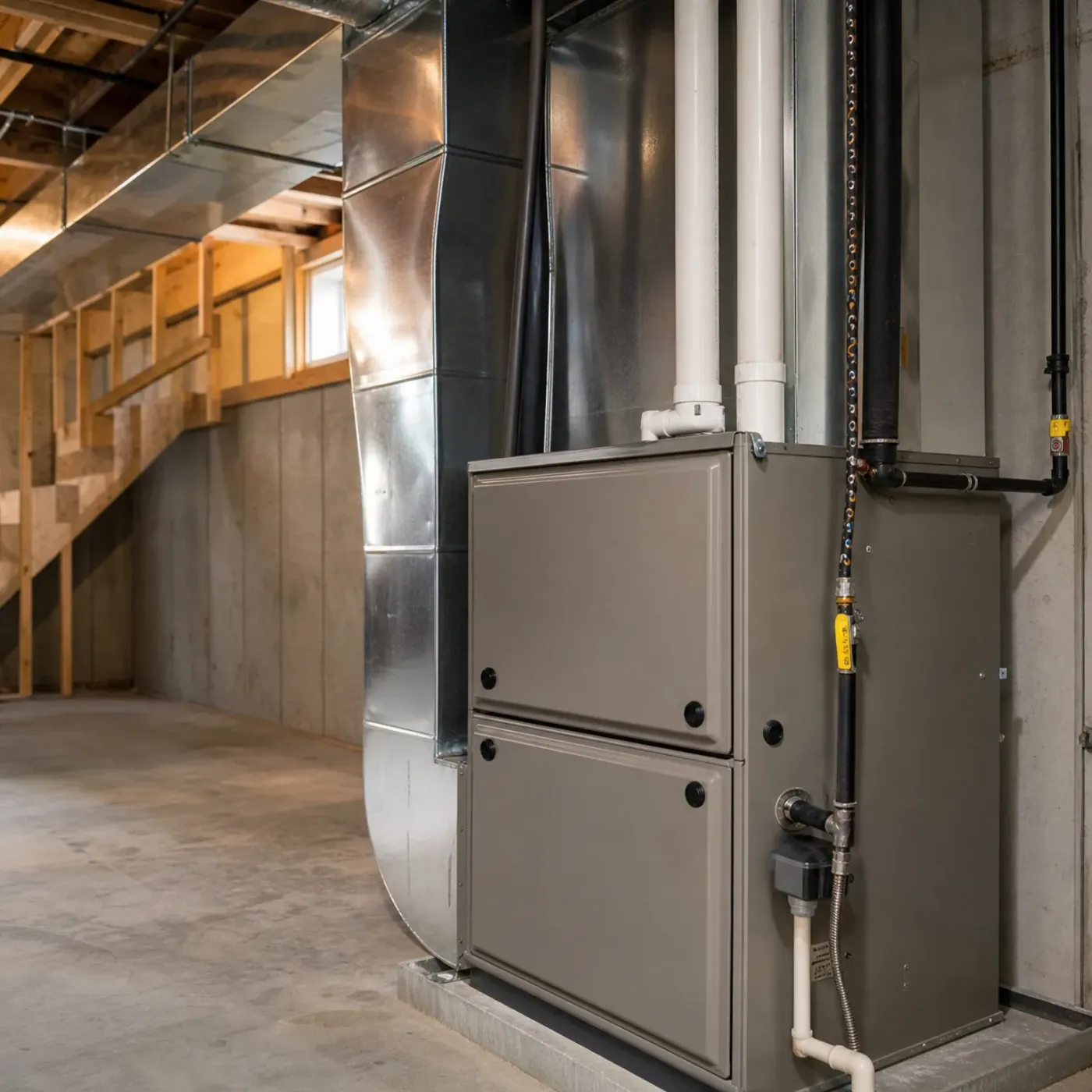
A gray high-efficiency furnace with white PVC vent pipes stands on a concrete pad in a basement, beside sheet-metal ductwork, copper piping and a poured concrete wall with wood framing at left.
A furnace venting and draining the way it should, the condensate line carrying water straight out to the drain.
A beige gas furnace in a basement with a metal flue pipe, galvanized sheet-metal ductwork to its left, and gas and water pipes along the concrete wall to its right.
A furnace left with a cracked trap or a blocked line, water finding its way out through the cabinet instead.

What are you seeing around your furnace right now

Water on the floor near the furnace, usually a small puddle that comes back even after you wipe it up. Sometimes it's a stain spreading across the carpet or drywall nearby instead of standing water. You might hear a hissing or gurgling sound from the unit, or notice the furnace short cycling, shutting off before the house warms up. If it's been going on a while, check for rust on the cabinet or the floor underneath, water finds metal eventually and starts eating through it. A musty smell means the water's been sitting long enough to grow mold. None of this stops the furnace from doing its job today, but a cracked heat exchanger or a flooded control board turns a simple drain clog into a repair that costs a lot more.

  1. Exhaust gases cool as they pass through the PVC vent pipe.

  2. The cooled gas condenses into water inside the furnace.

  3. Condensate drips down into a trap near the inducer motor.

  4. Water flows from the trap through a plastic drain line.

A beige metal furnace with a louvered front panel stands on a concrete floor against a concrete wall, connected to galvanized sheet-metal ductwork and a metal pipe.
Before you get your furnace repair
A gray high-efficiency furnace stands on a concrete basement floor beside sheet-metal ductwork, with white PVC vent pipes and a black flexible line running up to exposed wood floor joists, next to a wood-framed post against a concrete wall.
After you get your furnace repair
A gray high-efficiency furnace in an unfinished basement, connected to large galvanized sheet-metal ductwork, PVC vent pipes, a gas line and flexible conduit, with concrete walls, wood framing and a staircase in the background.

Get matched with a furnace pro in Warren County

Send the request today and let a furnace pro reach out to you.

Your request goes to a Warren County pro who takes furnace jobs.

Get a furnace pro

There's no charge for the request.

Clear It Yourself or Call Someone

Clear it yourself

  • A wet-dry vacuum at the outside end of the drain line can pull a clog free if the blockage sits near the exit point.
  • A mix of water and vinegar poured into the line's access point can break up algae without taking the furnace apart.
  • You avoid a service call if the problem really is just buildup in the line and nothing else.
  • You still need to find where the line runs and where it drains, and some furnaces hide that access behind panels.
  • If the clog sits further back near the trap, pulling it loose from the outside end often won't reach it.
  • Water that keeps coming back after you clear it once usually means the slope of the line or the trap itself is the problem, not something a vacuum fixes.

Have it looked at

  • A contractor can trace the line from the furnace to the drain and find exactly where the water is backing up.
  • Checking the trap near the inducer motor rules out a crack that no amount of clearing the line will fix.
  • A furnace that keeps shutting itself off on a safety switch points to a blockage that needs more than a vacuum to reach.
  • Getting it checked now, in the middle of a Mason winter, means the furnace keeps running through the cold nights instead of short-cycling.
  • A contractor can tell you in minutes whether this is a clogged line or a cracked part, instead of you guessing and taking the cabinet apart twice.
  • Water reaching drywall or carpet near the furnace is worth having looked at before it spreads further.
A woman in a cream knit sweater reclines on a beige couch with eyes closed and a slight smile, a gray hardcover book resting open on a textured blanket over her lap, with a lit table lamp and a leafy plant in the dim background.
A smiling middle-aged man in a dark green sweater sits at a candlelit table with a glass of red wine and a bowl of salad in the foreground.
A gray high-efficiency furnace in a basement with PVC vent pipes, sheet-metal ductwork, copper and insulated pipes, a water heater at left, and an unfinished wood-stud wall at right.

Draining the way it should

This is a high-efficiency furnace with PVC venting, the kind most homes in Mason have now. The condensate line runs clear to the drain with nothing holding it back, so the water never has a reason to go anywhere else.

An older beige furnace with louvered front panels stands on a concrete basement floor beside galvanized ductwork, metal and plastic pipes, exposed wood framing, and a cylindrical water heater at right.

Water finding another way out

This furnace is older, with galvanized ductwork and a line that's had years to collect algae and sludge. Once that line backs up, water works its way out through the cabinet instead of the drain, and you see it on the floor underneath.

Winter nights average 25°F

At 25°F, your furnace is firing almost nonstop through the night. That long runtime means hours of steady condensate production, so a line that's already partly clogged backs up faster and shows water sooner than it would on a milder night.

NOAA nClimDiv 1991-2020

A woman stands in the open front doorway of a single-story house with a covered porch, stone column bases and a dormer window, facing a man in a dark cap and gray polo shirt seen from behind in the foreground.

Water at the furnace has a cause, and it can be found

A furnace leaking water in Mason almost always comes down to the condensate line or the trap behind it, not something wrong with the furnace itself. Clear that path and the water stops. That holds true whether it's a clog that built up over a few cold weeks or a trap that's finally cracked after years of use.

You don't have to figure out which one it is on your own. A contractor matched to your situation can trace the line, check the trap, and tell you in minutes what's actually causing the water on your floor. From there it's a short conversation about what it takes to fix it, not a guessing game you're left to run yourself.


Living room interior with a light sofa holding a dark green cushion and a brown knit throw, a tall leafy plant by a black-framed window, a wooden coffee table with a round tray, and wooden shelves holding vases and books.
A dark-clad house with large windows beside a gravel driveway lined with in-ground path lights, ornamental grasses and hydrangeas, with distant hills and an orange sunset sky.

Furnace Repair

Find a furnace repair pro in Warren County

RepairFurnace or heatingWarren County, OH
Step 1 of 2

What ZIP code is the job in?

  • A beige upholstered armchair with a green cushion and a knitted throw sits beside a window with a rain-speckled pane, with a lit table lamp and bookshelf behind and a wooden side table holding a ceramic mug and a book.
    • A Warren County pro who repairs furnaces gets your request.
    • Get matched with a pro who fixes furnaces in Warren County.
  • A ceramic table lamp with a wide linen shade and a dark wooden bowl sit on a round wood side table beside a beige upholstered sofa with a chunky knit throw, in front of a curtained window.
    • Once you send the form, finding a pro is off your list.
    • After you send the request, you're done searching.
  • A living room with a light gray sectional sofa holding brown and cream textured pillows and a knit fringed throw, a rustic wood coffee table with stacked books and a stone vase of olive branches, built-in shelves with pottery, and a tall olive tree beside a curtained window.
    • Explain the furnace problem once instead of to every shop in Warren County.
    • Skip calling shops to ask who repairs furnaces in Warren County.
  • A ceramic urn-shaped table lamp with a mottled gray glaze and beige drum shade sits on a dark wood side table beside a potted green plant, next to a light beige upholstered sofa and a framed artwork on a gray wall.
    • The pro who gets in touch is licensed in Ohio and works in Warren County.
    • A licensed pro who works in Warren County gets your request.